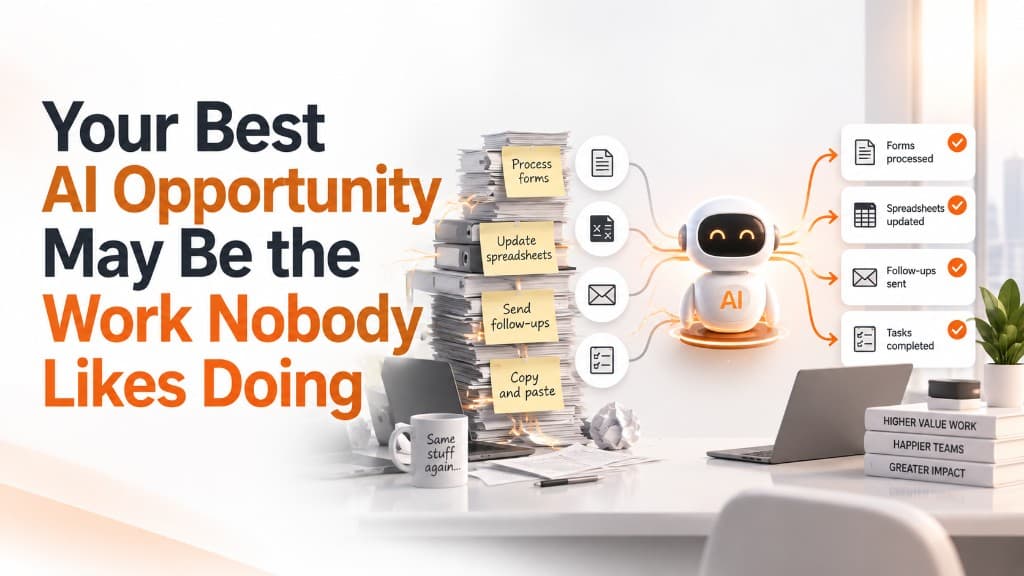
When business owners think about AI, they often look for something impressive.
An AI sales agent.
A chatbot that talks to customers.
Predictive analytics.
Automated marketing campaigns.
A system that can make decisions on its own.
Those projects can be valuable.
But your best first AI opportunity may be much less exciting.
It might be the spreadsheet someone updates every Friday.
The follow-up emails your team keeps forgetting to send.
The notes an employee has to turn into a report.
The information copied from one system into another.
The reconciliation somebody dreads doing at the end of every month.
In other words:
Your best AI opportunity may be the work nobody likes doing.
And that isn't a bad thing.
Look for Friction, Not Flash
A good AI project doesn't need to impress people in a demo.
It needs to improve the business.
One of the easiest places to find opportunities is to ask employees:
"What task do you wish you didn't have to do every week?"
You will usually get answers quickly.
- "I spend hours updating this report."
- "I have to copy the same information into three different systems."
- "I spend Monday morning following up on missing paperwork."
- "I have to read all these notes and summarize them."
- "I spend half a day scheduling appointments."
Those tasks may not sound transformational.
But repeated across weeks, months, departments, and employees, they consume meaningful amounts of time.
Repetition Is a Clue
Tasks become stronger AI or automation candidates when they happen frequently.
Suppose one employee spends 20 minutes preparing a weekly report.
Automating it saves about 17 hours per year.
Helpful.
Now imagine five employees each spend an hour every day categorizing requests, entering information, and routing work.
The opportunity is much larger.
Frequency changes the economics.
This is why businesses should ask:
- How often does this happen?
- How many people do it?
- How long does it take?
- Does the delay affect other work?
Small inefficiencies become large when they repeat often enough.
Good AI Work Often Has a Pattern
AI and automation tend to be easier to implement when the task has some consistency.
For example:
- Read this information.
- Identify these fields.
- Put them here.
- Summarize this document using this format.
- Classify this request into one of these categories.
- Draft a response using these approved rules.
- Compare these two records and flag differences.
Those tasks have boundaries.
The business can define what success looks like.
Compare that with:
"Run our entire company."
The second goal sounds more impressive.
It is also much harder to implement safely.
A narrow, repetitive task often gives businesses a better place to learn how AI behaves before expanding into higher-risk workflows.
Documentation Is a Good Example
Consider meeting notes.
An employee sits in a 45-minute meeting.
Then they spend another 20 minutes writing a summary, organizing action items, and preparing follow-up information.
What part of that work actually requires human judgment?
The employee may need to confirm priorities or decide whether a commitment is realistic.
But AI may be able to:
- Create a first draft of the meeting summary.
- Identify action items.
- Organize notes.
- Prepare a follow-up message.
Now the employee reviews the output instead of starting from a blank page.
AI didn't eliminate the meeting.
It reduced some of the administrative work surrounding it.
That's often where the value is.
Follow-Up Is Another Strong Opportunity
Many businesses don't have a lead-generation problem.
They have a follow-up problem.
A prospect asks for information.
A customer needs a check-in.
A proposal was sent.
An invoice needs attention.
A project is waiting for someone to respond.
The next step exists.
Nobody does it consistently.
AI and automation can help businesses identify those moments and make sure they don't disappear.
That might mean:
- Generating a draft follow-up.
- Reminding an employee.
- Scheduling the next touchpoint.
- Summarizing the previous conversation.
- Escalating overdue items.
The goal isn't to make every interaction robotic.
It's to stop routine work from depending entirely on somebody remembering to do it.
Data Entry Is Boring for a Reason
Employees rarely get excited about copying information from one system into another.
That's a clue.
Imagine receiving a form by email.
Someone opens it.
Reads the information.
Copies the customer's name into the CRM.
Copies the phone number.
Creates a record.
Updates a spreadsheet.
Then emails another employee to say it is finished.
There may be several opportunities in that workflow:
- Extract the form information automatically.
- Validate required fields.
- Create or update the customer record.
- Trigger the next step.
- Notify the appropriate person.
Some of that may involve AI.
Some may simply involve automation or integration.
That's okay.
The goal is not to maximize the amount of AI. The goal is to minimize unnecessary work.
Don't Automate Something Just Because Employees Hate It
This distinction matters.
A task being unpopular does not automatically make it a good automation candidate.
Sometimes unpleasant work contains important judgment.
Consider reviewing a serious customer complaint.
An employee may dislike it because the conversation is uncomfortable.
That doesn't mean the entire interaction should automatically be handed to AI.
Before automating, ask:
- Does this require judgment?
- Are there significant exceptions?
- Could an error hurt a customer?
- Does it involve sensitive information?
- How easily can someone verify the result?
- What happens if AI gets it wrong?
NIST's Generative AI Risk Management Profile specifically addresses the risk of confidently incorrect AI outputs and notes that those risks become particularly important when AI is used in consequential decision-making.
Low-risk administrative work is very different from a high-consequence decision.
What Makes a Good AI Automation Candidate?
A promising opportunity often has several characteristics:
- It happens frequently.
- It follows a reasonably consistent pattern.
- It consumes meaningful employee time.
- The inputs are available digitally.
- The result can be reviewed or measured.
- Mistakes can be detected before they cause serious harm.
- There is a clear business benefit if the process improves.
Not every good use case will check every box.
But the more it does, the more promising it becomes.
Ask Employees Where the Real Work Is
Leadership doesn't always know where employees lose time.
A CEO may see a completed weekly report.
They don't see someone spending three hours preparing it.
A manager sees a customer record.
They don't see someone copying information from an email, correcting formatting, searching for missing information, and updating three systems.
That's why AI discovery should include the people doing the work.
Ask:
- What do you repeat every day?
- What do you copy and paste?
- What do you have to remember manually?
- What requires the same steps every time?
- Where do you wait on someone else?
- What task would you gladly never do again?
Those questions often reveal better opportunities than asking:
"What should we use AI for?"
The Goal Is Capacity, Not Just Automation
Saving time isn't valuable unless the business knows what it wants to do with that time.
If AI saves an employee five hours a week, where should those hours go?
- Customer relationships?
- Sales?
- Quality control?
- Strategic work?
- Faster response times?
- More capacity without hiring at the same pace?
The value is not merely:
"The task now takes less time."
The value comes from what the business can accomplish with the capacity it created.
Recent McKinsey research reinforces this broader point: organizations creating more meaningful AI value are redesigning workflows and operating models around people and technology rather than simply deploying isolated tools.
Start Small Enough to Learn
Businesses sometimes believe an AI project needs to transform an entire department to be worthwhile.
It doesn't.
A well-chosen smaller process can help you learn:
- How employees interact with AI.
- Where data problems exist.
- What level of human review is necessary.
- How reliable the output is.
- Whether employees actually use the new workflow.
- How much time is really being saved.
Then improve it.
Then expand.
That is often safer and more effective than trying to automate everything at once.
The Boring Work May Be Where the Value Is Hiding
AI doesn't have to look futuristic to be useful.
Sometimes the best project doesn't involve an autonomous agent or an impressive dashboard.
Sometimes it means an employee no longer spends Friday afternoon copying information into a report.
Sometimes it means every lead gets followed up with.
Sometimes meeting notes are ready in minutes instead of an hour.
Sometimes someone spends more time talking to customers instead of entering data.
At AI2Grow, we believe the best AI opportunities begin with understanding how the business actually works.
Not:
"Where can we put AI?"
But:
"Where are people spending time that doesn't require the best of their abilities?"
Start there.
Because the work nobody likes doing may be exactly where AI can create the most immediate value.
If you want help finding that work in your own operations, our free AI Readiness Session starts with how the business actually runs.
Ready to implement AI the right way?
Let's have an honest conversation about your business and whether we're the right fit.
Schedule a Strategy Call →