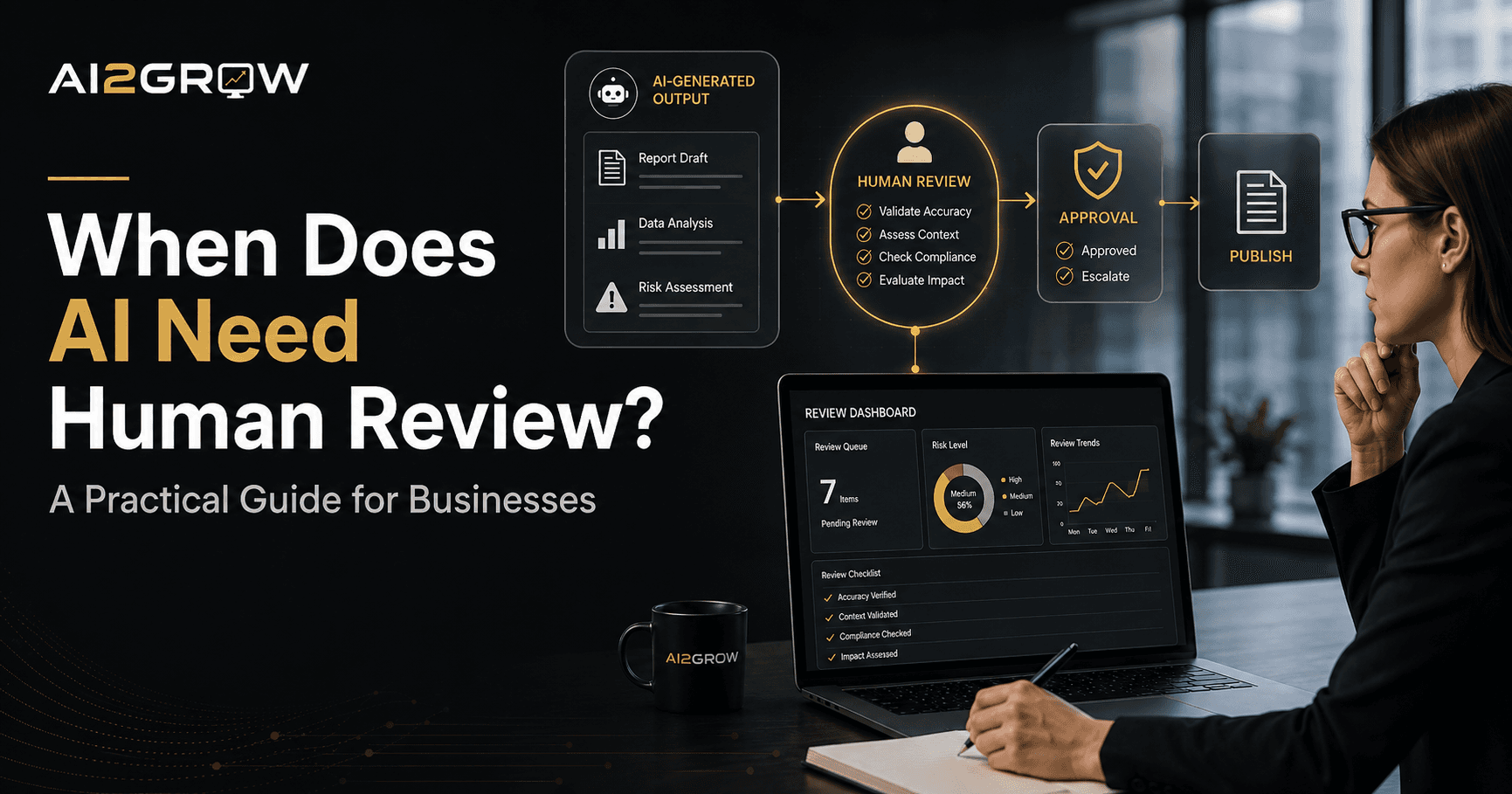
AI can automate repetitive work, speed up decisions, and help employees process information faster. But before any AI workflow goes live, one question should be answered:
How much human oversight does this process need?
The answer should not be the same for every workflow. A tool that helps brainstorm social media headlines does not need the same level of review as a system that influences a hiring decision, prepares a financial recommendation, or handles sensitive customer information.
The right amount of oversight depends on the risk and impact of the task. The goal is not to put a human in front of every AI-generated output — that can erase much of the efficiency AI is supposed to create. The goal is to determine where human judgment matters most.
What Does Human Oversight Actually Mean?
Human oversight means deciding where a person remains responsible for reviewing, approving, correcting, or monitoring an AI-supported process.
That might mean reviewing every output, spot-checking results, escalating unusual situations, or requiring approval only for higher-risk decisions.
Oversight does not always mean manually checking everything. A well-designed AI workflow can automate routine work while still creating clear points where human judgment is required.
Why Human Review Still Matters
AI can process information quickly, identify patterns, generate content, and handle repeatable tasks at scale. But speed does not eliminate risk. AI-generated outputs can still be incorrect, incomplete, misleading, inconsistent, or inappropriate for a specific situation.
A good workflow assumes that AI may occasionally get something wrong. The question is: what happens when it does?
If the consequences of an error are minor, the business may be comfortable with limited review. If the consequences are significant, human oversight becomes much more important. This is one of the core reasons most AI implementations fail — businesses treat oversight as an afterthought instead of a design decision.
Think About Risk, Not Just Automation
One of the easiest ways to determine how much oversight an AI workflow needs is to consider the potential impact of a mistake.
Ask:
- Could an error cost the business money?
- Could it negatively affect a customer?
- Could it expose confidential information?
- Could it create a legal or compliance issue?
- Could it influence an employee decision?
- Could it damage the company's reputation?
- Would the error be difficult to detect afterward?
The greater the potential impact, the more human oversight the workflow should have.
A useful principle is: the level of review should match the level of risk.
Low-Risk AI Workflows
Some AI tasks have relatively low consequences if the output is imperfect.
Examples might include brainstorming marketing ideas, creating blog topics, summarizing internal meeting notes, reformatting non-sensitive information, or drafting internal outlines.
These tasks often require only light oversight. An employee may review the output as part of normal work without needing a formal approval process. The AI helps the person work faster, while the employee still owns the final result.
Medium-Risk AI Workflows
Other tasks may have a greater impact and should receive more structured review.
Examples include drafting customer emails, preparing management reports, summarizing customer feedback, creating sales follow-up content, producing marketing copy, and drafting proposals.
In these workflows, businesses may not need executive approval for every output, but they should define clear review expectations.
For example, AI can draft a customer email, but an employee reviews it before sending. AI can summarize management data, but a manager verifies important numbers and conclusions. AI can create marketing copy, but someone reviews the final version for accuracy, tone, and brand standards.
This allows the business to benefit from automation while maintaining accountability.
High-Risk AI Workflows
Some workflows should have strong human oversight because mistakes could have serious consequences.
These may include AI that influences hiring, financial recommendations, legal or compliance work, customer eligibility, contract interpretation, significant pricing decisions, or sensitive customer and company data.
In these situations, AI should generally support human decision-making rather than replace it. For example, AI may help organize candidate information, but a qualified person should remain responsible for the hiring decision. AI may summarize a contract, but that summary should not automatically become the company's legal interpretation.
The higher the stakes, the more important it is to define where AI stops and human responsibility begins. This is exactly the kind of work that belongs inside a real AI governance framework — not left to individual judgment on the fly.
Three Levels of Human Oversight
A practical way to design AI workflows is to think in three levels.
Level 1: Human Reviews the Final Output
This works well for low- to moderate-risk tasks. AI completes most of the work, but a person checks the final result before it is used.
Examples include drafting emails, proposals, reports, or marketing content.
Level 2: Human Reviews Exceptions
For more mature workflows, AI may handle routine situations automatically while unusual cases are sent to a person.
For example, an AI-supported customer service workflow might categorize common requests automatically but escalate unusual, sensitive, or high-value cases to an employee. This lets people focus their attention where it is most valuable.
Level 3: Human Approves the Decision
High-impact workflows may require explicit human approval before an action is taken. AI can gather information, summarize options, or make a recommendation — but a person makes the final decision.
This is appropriate when mistakes could have significant consequences.
The Cost of Too Much Oversight
It is possible to overcorrect.
If employees must manually review every word, calculation, and recommendation produced by AI, the business may eliminate much of the efficiency it hoped to gain.
The goal should not be: *"A human must check everything."*
The better question is: "Where does human judgment create the most value?"
If a workflow is repeatable, low-risk, and easy to monitor, heavy review may not be necessary. If it is unpredictable, sensitive, or high-impact, the opposite may be true.
The Cost of Too Little Oversight
Removing people from a workflow too quickly creates a different problem.
Errors may go unnoticed, employees may trust polished but inaccurate outputs, and customers may receive incorrect or inappropriate responses.
A process should not become fully automated simply because the technology makes it possible. Automation should happen because the business has enough confidence in the workflow, controls, and measurement process to support it.
Questions to Ask Before Reducing Human Review
Before removing a review step, ask:
- How often does the AI produce an incorrect result?
- How serious would that error be?
- Can the error be detected automatically?
- Is the underlying data reliable?
- Does the workflow involve confidential or sensitive information?
- Does AI influence a customer or employee decision?
- Who is responsible if the output is wrong?
- How will we know if performance begins to decline?
If those questions cannot be answered clearly, the workflow may not be ready for less oversight.
Human Oversight Should Change Over Time
The right level of review at launch may not be the right level six months later.
A new AI workflow may initially require employees to review nearly every output. As the process becomes more reliable, the business may move to spot checks or exception-based review. If the workflow later involves more sensitive information or higher-impact decisions, additional oversight may be needed.
Human review should be treated as part of the workflow design, not as a permanent setting.
A Practical Next Step
The question is not whether AI should have human oversight, but where that oversight belongs.
Start by mapping one AI-supported workflow and identifying:
- What AI is responsible for
- What the employee is responsible for
- Where errors could occur
- How serious those errors would be
- Which outputs require review
- Who approves high-impact decisions
- How the workflow will be monitored over time
If you're not sure where your business stands, our free AI Readiness Session will walk you through exactly this — a real conversation about where AI fits in your operations and where human judgment still needs to lead.
At AI2Grow, we help businesses design AI governance frameworks that create efficiency without removing the judgment, accountability, and controls the business still needs.
The goal is not to keep humans involved in every step. It is to keep them involved in the right steps.
A strong AI workflow does not eliminate human judgment. It uses it where it matters most.
Ready to implement AI the right way?
Let's have an honest conversation about your business and whether we're the right fit.
Schedule a Strategy Call →