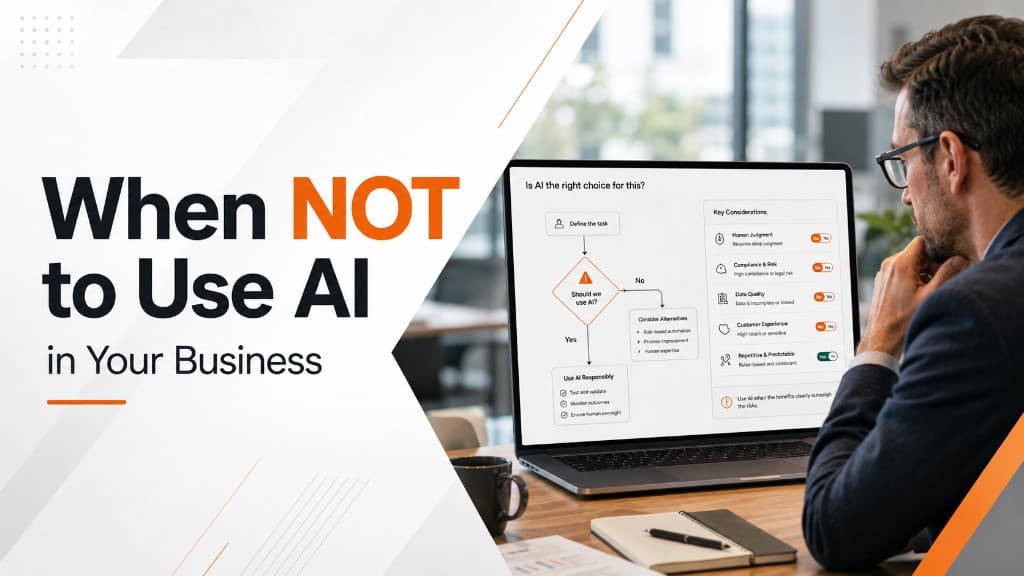
There is an important question missing from many AI strategy conversations:
What should a business not use AI for?
When every new software platform seems to promise an AI feature, it is easy to start with the technology and work backward toward a problem.
That reverses business logic.
A better approach is to begin with the problem and then decide whether AI is the best solution.
Sometimes it is.
Sometimes conventional automation, better software, a clearer process, or a simple rule will work better.
And sometimes the smartest decision is to leave the process alone.
Knowing when not to use AI is part of having a good AI strategy.
What Does "Don't Use AI" Actually Mean?
It does not mean ignoring AI or assuming the technology is too risky.
It means recognizing that AI is one tool among many.
AI tends to be useful for large amounts of information, repetitive cognitive work, pattern recognition, classification, summarization, and content transformation. But many business problems are better solved with a spreadsheet, database query, workflow automation, or process change.
The goal is not to use AI wherever possible. It is to choose the solution that produces the best business outcome.
1. Don't Use AI Just Because a Process Is Manual
Manual does not automatically mean inefficient.
Suppose an employee spends 20 minutes once a month reviewing a small report. AI could help, but configuration, testing, training, monitoring, and review may create more work than the original task.
A process that consumes ten employee hours every week, creates frequent errors, and becomes harder to manage as the business grows is a much stronger candidate.
Before introducing AI, ask:
How much is this process actually costing us?
If leadership cannot quantify the problem, it will be difficult to know whether the AI solution created meaningful value.
2. Don't Use AI When a Simple Rule Is More Reliable
AI systems are probabilistic.
In practical terms, that means they may produce different outputs from similar inputs.
That can be useful for tasks such as summarizing a document, drafting content, interpreting unstructured information, or suggesting possible next steps.
It is less useful when the correct answer is already governed by a simple deterministic rule.
If a business calculates commissions using a fixed formula, for example, traditional software will generally be easier to test, predict, and audit than an AI model.
If an invoice should automatically be routed to a manager whenever it exceeds a defined amount, a workflow rule may be all that is needed — the same distinction we draw between AI tools and process automation.
There is little strategic value in introducing uncertainty where certainty is already available.
3. Don't Use AI When the Cost of an Error Is Too High
Some processes can tolerate occasional mistakes.
Others cannot.
AI-generated output affecting medical treatment, legal conclusions, financial transactions, safety-critical operations, compliance decisions, or other high-impact activities may require levels of accuracy, accountability, and oversight that an AI system should not independently provide.
That does not automatically mean AI has no role. It may assist a qualified employee by summarizing information, identifying patterns, or preparing a draft for review.
But there is an important distinction between AI assistance and AI authority. The greater the consequence of a mistake, the stronger the need for human review, controls, and clear accountability.
4. Don't Use AI Before Fixing the Data Problem
AI depends on information.
If customer records are incomplete, product information is inconsistent, important documents are outdated, or data is scattered across disconnected systems, adding AI may simply make the underlying problem harder to see.
An AI system can process poor information quickly.
That does not make the result reliable.
Before building an AI workflow around business data, ask:
- Is the necessary data available?
- Is it accurate enough for the intended use?
- Is it stored in a usable format?
- Does the business have permission to use it?
- Is sensitive information appropriately protected?
- Who is responsible for maintaining it?
- How will outdated information be corrected?
If those answers are unclear, improving the process and the data foundation may create more value than adding AI.
5. Don't Use AI When the Economics Don't Work
AI has costs beyond the software subscription.
Depending on the use case, costs may include implementation, integration, data preparation, employee training, human review, usage fees, security, monitoring, maintenance, and future changes.
The business case should evaluate the net improvement, not just the time the AI appears to save. That is the same standard we use when measuring AI ROI.
Imagine a workflow that saves ten hours of employee effort each month but requires six hours of review, correction, and troubleshooting.
The real capacity gained is closer to four hours.
That may still be worthwhile, but leadership should make the decision using the actual result.
AI should not be considered successful simply because a task became automated.
It should improve an outcome that matters.
6. Don't Use AI Where the Human Process Is the Advantage
Not every process that takes time is inefficient.
Sometimes the time is part of the value.
A salesperson may spend significant time talking with customers because relationship-building is one of the company's competitive advantages.
A consultant may carefully review a client's situation because the client is paying for judgment and context.
A manager may conduct one-on-one conversations because trust and employee development cannot be reduced to the fastest possible transaction.
AI may still assist by summarizing notes, preparing information, or reducing administrative work. But replacing the human part may remove the thing customers or employees value most.
The question is not simply:
Can AI perform this task?
It is:
Does performing this task with AI produce a better business outcome?
7. Don't Use AI When Nobody Owns the Result
AI does not eliminate responsibility.
If an automated workflow creates the wrong answer, sends an inappropriate response, misclassifies information, or fails entirely, someone still needs to know what happened and what to do next.
Every meaningful AI-enabled process should have a clear owner.
That owner should understand what the AI is supposed to do, how output is reviewed, what happens when the system fails, who can change the workflow, and when the tool should be paused or removed.
Without ownership, problems can remain hidden because everyone assumes the technology is someone else's responsibility — one of the reasons most AI implementations fail.
8. So When Should a Business Consider AI?
AI becomes more compelling when there is a meaningful business problem, repetitive or information-heavy work, measurable inefficiency, usable data, tolerable risk, clear ownership, and a benefit that can be measured.
A pilot should also be testable before full rollout so leadership can determine whether the improvement is real.
That is an important distinction.
The goal is not to find processes that AI can touch.
It is to find processes where AI can create a measurable improvement.
A Better Question Than "Where Can We Use AI?"
Instead of asking every department to find something to automate, leadership can start with a more useful question:
What process is expensive, slow, inconsistent, difficult to scale, or frustrating employees?
Then examine the available solutions.
The answer may be AI, conventional automation, better software, or a process redesign. Sometimes the problem is not significant enough to justify changing anything.
That is not a failure of AI strategy.
It is evidence that the strategy is focused on business results rather than technology for its own sake.
Where AI2Grow Fits
AI2Grow starts with the business problem rather than assuming AI is the answer.
We help businesses identify where AI has a realistic opportunity to improve efficiency, capacity, customer experience, decision-making, or revenue — and where another approach may make more sense.
That can mean recommending AI, improving the process first, using conventional automation, or deciding that AI is not the right fit yet.
A successful AI strategy should not produce the largest possible number of AI projects.
It should produce the right projects, with measurable outcomes, clear ownership, manageable risk, and a reasonable path from implementation to value.
Sometimes the smartest AI decision is knowing when not to use it.
If you want help deciding where AI belongs in your business — and where it does not — our free AI Readiness Session starts with the problem, not the tool.
Ready to implement AI the right way?
Let's have an honest conversation about your business and whether we're the right fit.
Schedule a Strategy Call →