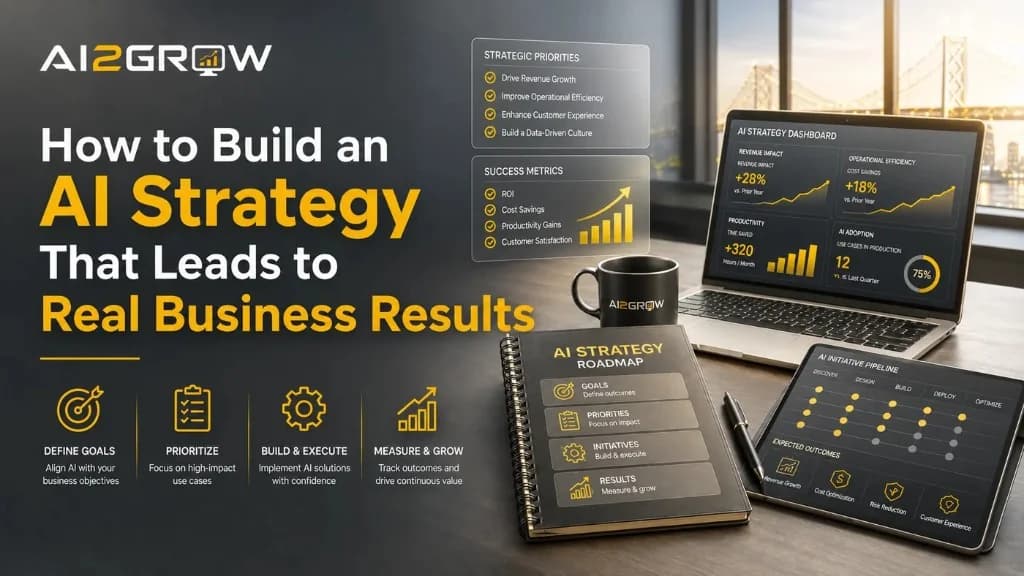
AI has become a regular topic in leadership meetings. Competitors are announcing new initiatives, software vendors are adding AI features, and employees are experimenting with public tools.
That pressure can make businesses feel as though they need an AI strategy immediately.
But an AI strategy is not a slide deck, a list of tools, or a collection of pilot projects. It is a series of business decisions about where AI should be used, where it should not be used, and what results would make the investment worthwhile.
A useful strategy starts with the business—not the technology.
What Is an AI Strategy?
In simple terms, an AI strategy is a plan for using AI to solve specific business problems while supporting the organization's broader goals.
It should answer questions such as:
- Which problems are worth solving?
- Where could AI save time, reduce costs, or improve service?
- Which processes should remain primarily human?
- Is the available data reliable?
- Who will own each initiative?
- How will success be measured?
- What risks need to be addressed?
Those decisions matter more than the document in which they are recorded.
A detailed roadmap is not useful if leadership cannot explain what AI is expected to improve or how the business will know whether an initiative is working.
The Biggest Mistake: Confusing Activity With Progress
AI creates pressure because it is highly visible. Boards ask about it, employees test new tools, and vendors promote automation.
That urgency can lead to activity without direction:
- Purchasing tools before identifying a use case
- Launching pilots without clear goals
- Automating inefficient processes
- Allowing departments to pursue unrelated initiatives
- Measuring how many tools were tested instead of what improved
An AI initiative is not successful simply because it uses advanced technology. It is successful when it creates a measurable business improvement.
Sometimes the smartest decision is to wait, improve the process first, or conclude that AI is not the right solution.
Does Every Business Need a Formal AI Strategy?
Not every organization needs a comprehensive AI plan today.
A formal strategy may not be necessary when employees are only experimenting with low-risk tools, leadership has not identified a meaningful outcome, or the company's main challenges involve inconsistent processes or unreliable information.
In those situations, learning and preparation may be more valuable than immediate implementation.
A structured strategy becomes more important when:
- Multiple departments are independently using AI tools
- The company is considering a significant investment
- AI may affect customers, finances, compliance, or important decisions
- Employees perform large amounts of repetitive, information-heavy work
- Leadership needs a consistent way to prioritize opportunities
The need for a strategy depends less on company size and more on the level of investment, risk, and operational dependence involved.
A Practical Framework for Building an AI Strategy
A useful strategy does not need to be complicated. It should create a repeatable process for evaluating opportunities and making decisions.
1. Start With the Business Objective
Before discussing tools, identify what the business is trying to improve.
Possible objectives might include:
- Reducing administrative work
- Improving response times
- Making information easier to find
- Increasing consistency
- Improving reporting visibility
- Reducing errors in a repetitive process
The objective should be specific enough to measure.
"Use more AI" is not a business goal.
"Reduce the time required to prepare weekly operational reports" is.
2. Understand the Current Process
Before changing a workflow, leadership should understand how it operates today.
That includes who completes each step, which systems are involved, where delays occur, what information is required, and where employees rely on judgment.
AI cannot fix a process the business does not understand.
In some cases, reviewing the workflow reveals that the problem can be solved by simplifying the process, improving training, or using existing software more effectively.
3. Rank the Best Opportunities
Once the problem is clear, potential AI use cases can be compared based on:
- Expected business impact
- Potential time savings
- Quality of available data
- Cost and complexity
- Level of risk
- Ease of testing
- Ability to measure the result
The best first project is not always the most ambitious one.
A focused initiative with reliable data and clear measurements may create more value than a large project involving several departments.
4. Assess Readiness
AI depends on the information, systems, and people surrounding it.
Before implementation, the business should ask:
- Is the required information accurate and current?
- Is it stored in a consistent location?
- Can the necessary systems connect securely?
- Are access permissions appropriate?
- Do employees understand the process?
- Is someone available to maintain the solution?
Poor data and disorganized processes do not disappear when AI is introduced. In many cases, AI simply exposes those weaknesses faster.
5. Define Oversight and Risk
Not every AI use case requires the same controls.
An internal brainstorming tool creates less risk than a system that communicates with customers, handles sensitive information, or supports financial decisions.
The strategy should define:
- Which outputs require human approval
- What information employees may enter into AI tools
- Who can access each system
- How errors will be reported
- What happens if the AI becomes unavailable
- Which decisions must remain human
The level of oversight should reflect the consequences of an incorrect result.
6. Run a Limited Pilot
A pilot allows the business to test the idea before making a larger investment.
A useful pilot should include:
- A specific workflow
- A limited group of users
- Clear success measures
- A defined beginning and end
- A person responsible for the project
- A process for collecting feedback
The goal is not to prove that AI always works. It is to determine whether the solution creates enough value to justify continuing or expanding it.
7. Measure the Business Outcome
AI projects should be evaluated against the original objective.
Useful measurements may include:
- Hours saved
- Faster response times
- Fewer manual steps
- Reduced errors
- Improved consistency
- Better access to information
- Increased employee capacity
- Improved customer experience
Usage alone is not proof of value. Employees may use a tool frequently without creating a meaningful business improvement.
8. Decide Whether to Stop, Revise, or Scale
At the end of the pilot, leadership should make a deliberate decision.
- Stop: The project did not create enough value or introduced too much risk.
- Revise: The idea has potential, but the workflow, data, training, or controls need improvement.
- Scale: The pilot produced a measurable result, and the business is prepared to expand it responsibly.
Stopping an unsuccessful project is not a failed strategy. It is evidence that the evaluation process worked.
What a Strong AI Strategy Should Include
A practical AI strategy should connect every initiative to a business objective, focus on a small number of worthwhile opportunities, and acknowledge where AI may not be appropriate.
It should also establish clear ownership, measurable outcomes, security expectations, human oversight, and practical next steps.
Most importantly, it should remain useful after the planning meeting is over.
If it exists only as a presentation stored in a shared folder, it probably will not guide many real decisions.
AI Strategy Should Support Better Decisions
A strong AI strategy does not assume that every problem requires AI.
Sometimes the best solution is a process improvement.
Sometimes existing software can solve the issue.
Sometimes the business needs better documentation or cleaner data before introducing new technology.
And sometimes a focused AI implementation can create meaningful value.
The purpose of strategy is to make those decisions clearer and more consistent.
Where AI2Grow Fits
At AI2Grow, the goal is not to convince every business that it needs a large AI transformation.
The process begins by understanding how the organization operates, where work slows down, and which problems are worth solving. Potential AI opportunities can then be evaluated based on value, readiness, risk, and measurable results.
Sometimes that leads to a targeted pilot.
Sometimes the business should improve its data or processes first.
And sometimes the right answer is "not yet."
AI2Grow offers a complimentary strategy consultation to help businesses identify practical opportunities, prioritize potential use cases, and determine which ideas are worth testing.
Ready to implement AI the right way?
Let's have an honest conversation about your business and whether we're the right fit.
Schedule a Strategy Call →