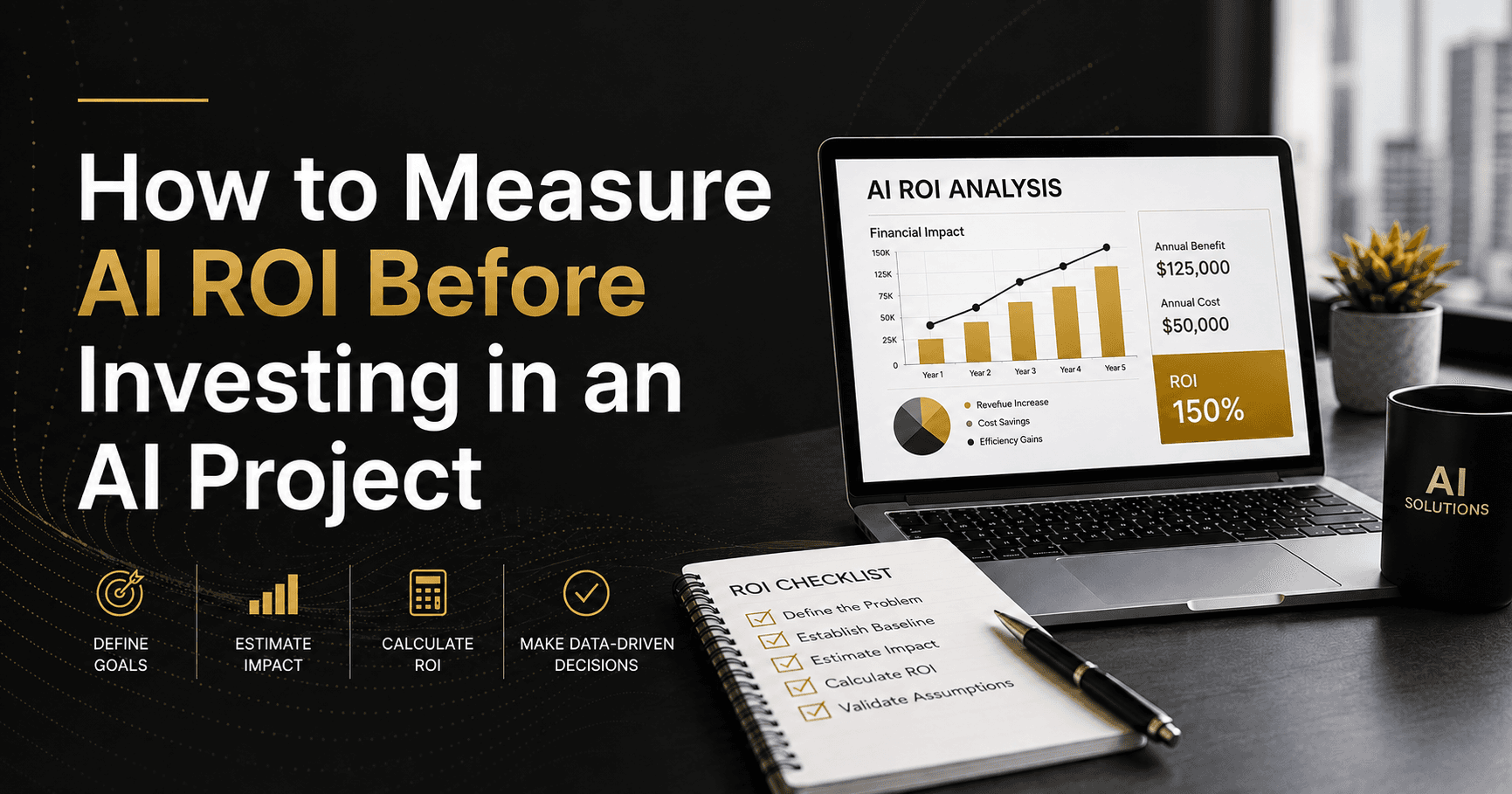
AI vendors are often quick to explain what their technology can do. Far fewer can clearly explain how success will be measured in your business.
Before approving a pilot project, signing a contract, or committing budget, ask one essential question:
How will we measure success?
If the answer is vague or impossible to quantify, it may be too early to move forward.
AI can create meaningful business value, but that value is easier to achieve when the business problem, expected outcome, and measurement plan are defined before implementation begins.
What Does AI ROI Mean?
ROI, or return on investment, helps determine whether an investment creates more value than it costs.
For an AI project, that value might come from:
- Saving employee time
- Reducing repetitive work
- Improving customer response times
- Increasing accuracy
- Preventing mistakes
- Reducing delays
- Creating capacity for growth
The key is to choose a measurable outcome before the project starts. Without a clear definition of success, almost any result can be described as a success afterward.
Why AI ROI Conversations Go Wrong
AI is often presented as transformational. Sometimes it is. But "transformation" is difficult to measure.
Statements such as "your team will become more efficient" or "employees will work smarter" may sound promising, but they cannot be evaluated without numbers and timelines.
A more useful conversation sounds like this:
> Your customer service team currently spends 25 hours each week answering repetitive questions. We believe an AI-supported workflow could reduce that time by 40%, and we will measure the results over 90 days.
That is no longer just a promise. It is a business case.
Start With a Baseline
Before measuring improvement, document current performance.
Your baseline might include:
- Hours spent on a task
- Average response time
- Error rates
- Cost per transaction
- Turnaround time
- Time spent searching for information
Without a baseline, you may know that a process feels better, but you will not know whether it actually improved. This is one of the reasons so many AI pilots never make it to scale — they never established what "better" was supposed to look like before starting.
A Simple Way to Estimate AI ROI
One simple way to estimate annual value is:
Hours saved per week × hourly employment cost × 52 weeks
Then subtract the full annual cost of the project, including software, implementation, training, maintenance, monitoring, and support.
A basic formula is:
ROI = (Estimated annual benefit − annual project cost) ÷ annual project cost × 100
This is not a guarantee. It is a planning tool that helps determine whether an opportunity is worth exploring.
A Practical Example
Imagine a customer service team spends 25 hours each week answering repetitive questions.
At a fully loaded employment cost of $35 per hour, that work costs approximately:
25 hours × $35 × 52 weeks = $45,500 per year
If an AI-supported workflow safely reduces that workload by 40%, the estimated annual capacity created would be:
$45,500 × 40% = $18,200
If the AI solution costs $10,000 per year, the estimated ROI would be:
($18,200 − $10,000) ÷ $10,000 × 100 = 82%
Leadership would still need to consider accuracy, customer experience, data security, employee adoption, and implementation risk. But the decision would now be based on a measurable opportunity rather than enthusiasm alone.
If you need help thinking through the real cost side of that equation, our breakdown on how much AI implementation actually costs is a useful companion piece.
You May Not Be Ready for AI If…
It may be too early to implement AI if:
- You cannot clearly describe the problem
- The process is inconsistent or poorly documented
- The underlying data is unreliable
- Nobody owns the project internally
- Success would be difficult to measure
- The likely cost is greater than the value of the problem
These are not permanent barriers. They are signs that foundational work may need to happen first. Sometimes documenting the process, improving existing software, or clarifying responsibilities will create more value than adding AI.
You May Be Ready for AI If…
AI becomes more compelling when it is applied to a repeatable problem with measurable costs.
Your business may be ready when:
- Employees spend significant time on repetitive tasks
- Customer response times affect revenue or retention
- Manual processes regularly create errors or delays
- Teams have identified a specific bottleneck
- The process happens frequently
- You know which business metric should improve
Notice that these conditions begin with the business — not the technology.
Questions to Ask Before Approving an AI Project
Before moving forward, ask:
- What specific problem are we solving?
- What does that problem currently cost us?
- What baseline metrics have we documented?
- Which business metric should improve?
- What are the full implementation and ongoing costs?
- Who owns the project internally?
- How will quality and risk be monitored?
- What happens if the expected results are not achieved?
A strong AI partner should welcome these questions. Our AI implementation services are structured around answering them before any technology gets deployed.
Not Every Benefit Appears Immediately
Some AI projects create direct financial returns. Others improve consistency, reduce employee frustration, support better decisions, or create capacity for future growth.
Those outcomes still matter.
The important thing is to be honest about what can be measured now, what may become measurable later, and what should be treated as a strategic investment. There is nothing wrong with making a strategic investment. There is something wrong with promising guaranteed ROI before the evidence exists.
A Practical Next Step
At AI2Grow, we help businesses evaluate AI opportunities before they invest heavily in tools or implementation. We review the business problem, current process, expected costs, and measurable outcomes to determine whether AI is likely to create real value.
Sometimes AI is the right answer. Sometimes the process needs to be improved first. Our goal is to help businesses make that decision based on the business case — not the hype.
Considering an AI project? Our free AI Readiness Session will help you identify one measurable business problem and the real cost of leaving it unchanged — before you spend a dollar on tools.
Ready to implement AI the right way?
Let's have an honest conversation about your business and whether we're the right fit.
Schedule a Strategy Call →