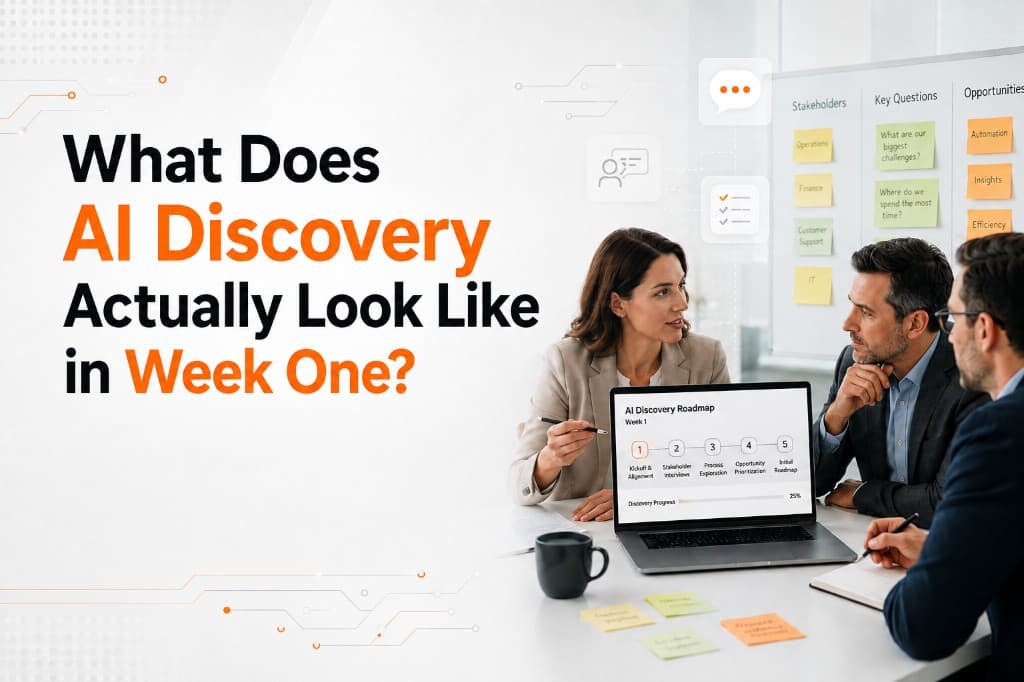
The first week of an AI project should probably be less exciting than you expect.
There may not be a list of shiny new tools.
There may not be ten automation projects ready to launch.
There may not even be a recommendation to use AI yet.
And that can be a very good thing.
A strong first week of AI discovery should give you something more valuable: clarity.
Clarity about how your business works today.
Clarity about where employees are losing time.
Clarity about which problems are worth solving.
Clarity about where AI may help.
And just as importantly, clarity about where it probably will not.
That process is AI discovery.
What Is AI Discovery?
AI discovery is the process of understanding your business before deciding where AI belongs in it.
That means looking at:
- Business goals
- Workflows
- Employee responsibilities
- Bottlenecks
- Repetitive tasks
- Data
- Existing systems
- Customer experience
- Risk
- Security
- Cost
- Human judgment
- Implementation constraints
The wrong way to begin is:
"Where can we put AI?"
The better question is:
"Where does our business have a problem worth solving, and is AI an appropriate way to solve it?"
That distinction matters.
Because if you begin with the technology, almost everything starts to look like an AI opportunity — which is one of the reasons most AI implementations fail.
If you begin with the business problem, many ideas quickly become less attractive.
Some may need traditional automation.
Some may need better software.
Some may need a clearer process.
Some may not be worth changing at all.
Good discovery helps you tell the difference before you spend serious time and money.
Step 1: Start With What the Business Is Trying to Accomplish
Before looking at workflows, establish what actually matters to the organization.
What are the priorities right now?
Maybe you need to:
- Improve customer response times
- Reduce administrative workload
- Grow without adding staff at the same rate
- Improve consistency
- Reduce errors
- Speed up sales follow-up
- Improve reporting
- Give employees time back
- Improve customer experience
- Reduce operational risk
This gives discovery a direction.
Otherwise, you can find dozens of interesting uses for AI that have very little connection to what the business actually needs.
A useful AI opportunity should support a real business objective.
Step 2: Talk to the People Doing the Work
Executives understand the goals.
Employees often understand the friction.
Both perspectives matter.
If you want to understand how a process really works, talk to the people who touch it every day.
Ask someone to walk you through:
- How a new lead gets handled
- How a proposal gets created
- How an invoice gets processed
- How a customer request gets routed
- How reports are built
- How new employees are onboarded
- How information gets entered into the CRM
- How approvals happen
- How recurring follow-up tasks are managed
Do not ask for the ideal process.
Ask for the real one.
Where does information arrive?
Who receives it?
What system does it go into?
What gets copied and pasted?
Who has to approve something?
Where does someone wait?
Where does someone re-enter information?
Where do mistakes happen?
Where does someone say:
"I have to remember to do this."
Those moments matter.
Step 3: Find the Friction Before You Find the AI
One of the most useful discovery questions is:
"What is frustrating about this process today?"
That usually reveals more than asking:
"What could AI do here?"
Employees may tell you things like:
- "I enter the same information three times."
- "I have to check two systems before I can answer the customer."
- "I spend two hours every Friday building this report."
- "If Susan is out, nobody knows where this information is."
- "We lose track of these requests."
- "I have to read every message and decide who it belongs to."
- "Customers keep asking for the same information."
- "I spend most of Monday cleaning up what came in over the weekend."
Those are business problems.
Now you have something worth investigating.
The Biggest Opportunities Often Live Between Systems and People
Many workflow problems do not happen inside a single piece of software.
They happen between steps.
A customer submits a form.
Someone receives an email.
Another employee creates a CRM record.
Someone else copies information into a spreadsheet.
A manager approves something.
An employee sends an update.
A report is created later.
Nothing in that chain may be dramatically broken.
But together, the handoffs consume time.
That is where discovery becomes valuable. It is also why business process optimization should come before any conversation about tools.
Look for:
- Repetitive copying and pasting
- Manual data entry
- Long approval chains
- Repeated customer questions
- Work waiting in inboxes
- Information spread across multiple systems
- Documents employees have to read and summarize manually
- Tasks that regularly get forgotten
- Decisions that follow the same pattern repeatedly
- Work that depends heavily on one employee's memory
These are often better starting points than asking employees to brainstorm futuristic AI ideas.
Step 4: Evaluate Each Opportunity the Same Way
Finding an idea is only the beginning.
A business may identify 20 possible uses for AI during discovery.
That does not mean it should pursue 20 projects.
At AI2Grow, we believe every opportunity should be evaluated using the same core questions.
1. Business Impact
What improves if this works?
Will it:
- Save meaningful employee time?
- Reduce costs?
- Improve customer experience?
- Increase revenue?
- Reduce errors?
- Reduce risk?
- Improve consistency?
If the outcome is vague, the opportunity probably needs more work.
2. Workflow Friction
How painful is the current process?
A process that happens once every six months may not deserve automation.
A process consuming 20 employee hours every week may be much more interesting.
Frequency matters.
Volume matters.
Cost matters.
Frustration matters.
3. Data Readiness
AI needs information.
Do you have it?
Is it accessible?
Is it accurate?
Is it organized well enough to use?
Can the system legally and appropriately access it?
A great idea with unusable data may not be a great project yet.
4. Feasibility
Can you realistically implement the idea?
What systems need to connect?
Does an integration already exist?
Would someone need to build one?
How much process change would be required?
How much employee training?
How much maintenance?
An idea can be valuable in theory and still be impractical today.
5. Risk
What happens if the AI is wrong?
That question changes everything.
If the AI generates a rough internal summary that an employee reviews, the risk may be relatively low.
If the AI is making a financial decision, sending information to a customer, handling sensitive data, or making a decision with legal consequences, the stakes are very different.
The higher the potential impact of an error, the more carefully the workflow needs to be designed.
6. Human Oversight
What should a person still review?
Some workflows can be highly automated.
Others should always include approval.
Human involvement is not automatically a failure of automation.
Sometimes it is exactly what makes the system useful and responsible.
The goal is to decide intentionally where people still need to be involved. Our guide on where human review actually belongs walks through how to match oversight to the risk of each workflow.
7. Measurability
How will we know whether this worked?
Before building anything, identify the baseline.
How long does the process take today?
How much employee time does it use?
How many errors occur?
How quickly do customers receive a response?
How many steps are involved?
If you do not know where you started, it becomes difficult to prove the project improved anything. That is why measuring AI ROI starts with a baseline, not with a finished project.
Step 5: Rule Out Bad Ideas
Discovery is not only about finding projects.
It is also about killing bad ones early.
That may be one of its greatest values.
An idea should probably be put aside if:
- Nobody can explain the business outcome
- The process does not happen often enough
- The potential savings are too small
- The required information does not exist
- The data cannot appropriately be used
- A simple automation can solve the problem
- Existing software already has the feature
- The risk of an incorrect result is too high
- Implementation would cost more than the expected benefit
- There is no practical way to test the idea
- Employees are unlikely to adopt the new workflow
A project does not become valuable simply because AI can technically perform the task.
Capability and business value are not the same thing. Sometimes an AI tool or a simple automation is the better fit, and discovery is how you find that out.
Step 6: Choose a Small Number of Opportunities
At the end of discovery, you should not have 50 AI use cases.
You should have a short list of worthwhile opportunities.
Ideally, each one has:
- A clearly defined business problem
- A measurable desired outcome
- An owner
- A known workflow
- Known system and data requirements
- Major risks identified
- A rough understanding of implementation difficulty
- A clear role for human review
- A reasonable way to test it
That is much more useful than a giant list of ideas.
Step 7: Test Small Before You Build Big
A promising idea does not need to become a company-wide AI transformation immediately.
Start narrow.
Suppose you discover that employees spend ten hours every week reading incoming requests and routing them to the correct department.
Do not begin by trying to redesign the entire customer-service operation.
Test whether AI can accurately categorize one type of incoming request.
Measure the result.
See where it fails.
Let employees use it.
Understand what still needs human review.
Then decide whether it deserves a larger investment.
A small, measured test is also the best way to avoid the pilot project graveyard — a technically successful demo that never becomes an operational tool.
The purpose of a small test is not to prove that AI is impressive.
It is to answer:
"Does this create enough business value to justify doing more?"
What Should You Have at the End of Week One?
Not necessarily software.
Not necessarily a giant strategy deck.
And not necessarily an AI project.
You should have better information.
A strong first week of discovery should leave you with:
- A clearer understanding of business priorities
- A picture of where employees are losing time
- A small number of problems worth investigating
- Defined success measures
- Known data and system requirements
- Identified risks
- A view of where human judgment still belongs
- A shortlist of possible tests
- A list of ideas that should not move forward
That is progress.
Good Discovery Does Not Force AI Into the Answer
At AI2Grow, we believe the purpose of discovery is not to justify an AI project.
It is to make a better decision.
Sometimes discovery will reveal an excellent AI opportunity.
Sometimes it will reveal that traditional automation is the better fit.
Sometimes a software setting needs to be changed.
Sometimes the workflow itself is the problem.
And sometimes the right answer is:
Not yet.
That is not a failed discovery.
That is exactly what discovery is supposed to tell you.
The goal is not to put AI everywhere.
The goal is to understand where technology can create meaningful, measurable improvement without adding unnecessary cost, complexity, or risk.
Before you ask what AI could do for your business, start with a simpler question:
Where is the work getting harder than it needs to be?
That is usually where the most useful opportunities begin.
If you want a structured look at that question — and whether AI, automation, or neither is the right next step — our free AI Readiness Session is built around this kind of discovery.
Ready to implement AI the right way?
Let's have an honest conversation about your business and whether we're the right fit.
Schedule a Strategy Call →