Your company may never employ 150,000 people.
But it may eventually manage more automated workers than you expect.
Gartner has predicted that the average Fortune 500 enterprise could have more than 150,000 AI agents in use by 2028, up from fewer than 15 in 2025.
That is an enormous number, and most small and midsize businesses will never operate at that scale.
But the exact number is not the important part.
The important part is the management problem underneath it.
Once AI systems are allowed to do more than answer questions—once they can access data, send messages, update records, trigger workflows, and take action on behalf of the organization—you need to know:
- Who owns them?
- What can they access?
- What are they allowed to do?
- Who is responsible when something goes wrong?
In other words:
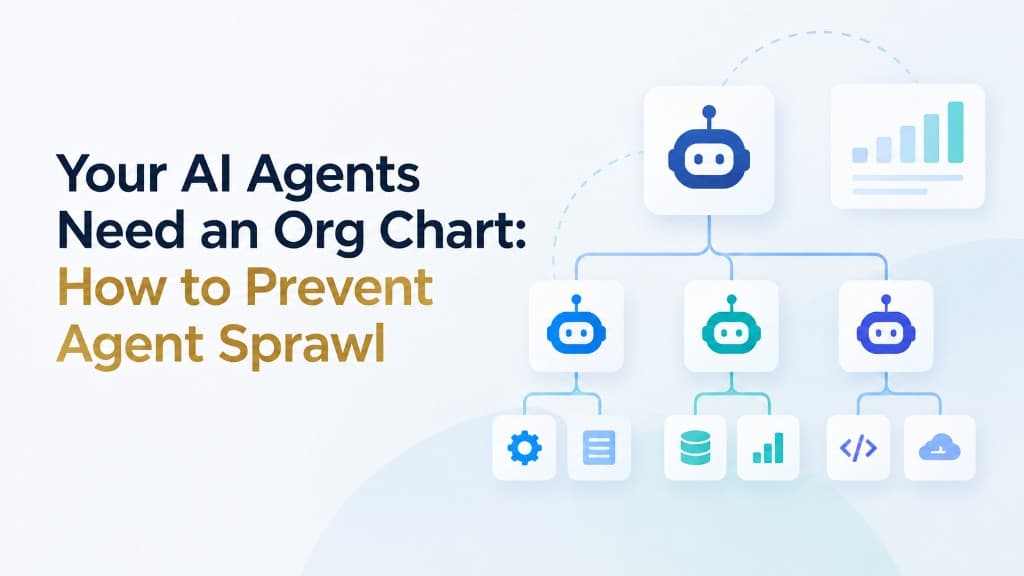
Your AI agents need something that looks surprisingly similar to an org chart.
What Is Agent Sprawl?
Agent sprawl happens when AI agents and AI-powered automations multiply across the business faster than anyone can track them.
It may begin innocently.
Sales creates an agent to summarize calls.
Finance experiments with one that reviews invoices.
Marketing builds an automated research workflow.
Operations creates an agent to move information between systems.
Customer service adds another to categorize incoming requests.
Individually, each tool may seem reasonable.
The problem appears when nobody has a complete picture of what exists.
One agent may have access to customer records.
Another may connect to company email.
Another may have financial information.
A fourth may duplicate a workflow built by another department.
A fifth may still be active months after the employee who created it leaves the company.
That is what makes agent sprawl different from simply having a lot of AI tools.
These systems may have permissions and authority.
They can potentially act on behalf of the company.
Why This Cannot Be an IT-Only Problem
It is tempting to assume IT should simply control every AI tool.
In reality, AI experimentation often starts outside IT.
Employees discover tools on their own.
Departments purchase software with built-in AI features.
Managers create automated workflows.
Business applications add AI functions without the company launching a formal AI initiative.
Trying to stop every experiment can create another problem: employees may simply move experimentation into unapproved tools or personal accounts.
That does not mean unrestricted AI use is a good idea.
It means governance needs to be practical — the same point we make in AI governance for growing companies.
The goal should not be to eliminate experimentation.
The goal should be to understand when experimentation becomes a real business system that needs oversight.
Treat Agents Like Employees With Different Levels of Authority
An org chart helps answer basic questions about people.
Who is responsible for what?
Who reports to whom?
What systems can they access?
What decisions can they make?
An AI environment needs similar structure.
For every production AI agent, your business should be able to identify seven things.
1. Purpose
What specific business task does this agent perform?
"Helps sales" is too broad.
"Summarizes sales calls and updates CRM notes" is much clearer.
2. Owner
Which person or team is accountable for the agent?
Every production agent should have a human owner.
If nobody owns it, nobody is responsible for reviewing its performance, correcting problems, updating it, or deciding when it should be shut down.
3. Identity
Can the organization clearly distinguish this agent from other systems and users?
This becomes increasingly important as agents connect to business applications.
You want to know what actions were performed by a person and what actions were performed by automation.
4. Permissions
What data and systems can the agent access?
An agent should not have broad access simply because broad access is convenient.
Permissions should match the work it actually needs to perform.
5. Authority
What can the agent do without human approval?
Can it draft a message?
Send it?
Update a record?
Issue a refund?
Create a purchase?
Modify customer data?
The difference between reading information and taking action is significant — and it is the same judgment behind when AI needs human review.
6. Lifecycle
When will the agent be reviewed?
Who modifies it when business processes change?
What happens when the employee or department that created it no longer needs it?
Every agent should eventually be updated, replaced, or retired.
7. Monitoring
How do you know whether the agent is behaving as expected?
Can its actions be reviewed?
Are logs available?
Can someone identify unusual behavior?
What happens when performance degrades?
Without monitoring, the business may not discover problems until an employee or customer notices them.
You Do Not Need Complicated Governance to Start
This may sound like enterprise bureaucracy.
It does not have to be.
A growing business can begin with something as simple as a spreadsheet.
For every agent, record:
- Name
- Purpose
- Owner
- Applications connected
- Data accessed
- Permissions
- Level of autonomy
- Human approval requirements
- Last review date
- Status
That may be enough to create visibility.
The important thing is that someone can produce a reasonable answer when leadership asks:
What AI agents are currently operating in our business?
If nobody knows, that is the first governance problem to solve.
Three Questions Every Business Should Ask
You can simplify AI-agent governance into three core questions.
1. What do we have?
Create an inventory.
Include formally approved agents and AI automations.
Also try to identify tools departments or employees may have created independently.
You may discover more AI use than leadership expected.
That is not unusual.
The point is not to punish experimentation.
The point is to make the invisible environment visible.
2. What can they touch?
Not all agents create the same risk.
An agent summarizing public marketing content is very different from one that can access:
- Customer records
- Employee information
- Contracts
- Financial information
- Internal email
- Company files
- Production systems
Access should be proportional to the task.
If an agent only needs customer names and appointment dates, it should not automatically receive access to every field in the customer database.
This is the same principle businesses already use with employees:
Give access based on need.
3. What happens when the agent makes a mistake?
Every production AI agent needs an answer to this question.
Can a human review the result?
Can the action be reversed?
Is there a log?
Who gets notified?
Can the system be stopped quickly?
What happens if the agent sends the wrong message?
Updates the wrong record?
Misinterprets a request?
Uses the wrong information?
The more consequential the task, the stronger those controls should be.
When You Need More Governance
Not every AI experiment requires the same level of oversight.
A low-risk assistant that helps an employee brainstorm headlines probably does not need the same controls as an agent that can modify customer records.
Governance should become stronger when an agent:
- Handles sensitive or regulated information
- Makes decisions affecting customers or employees
- Sends external communications
- Changes records
- Initiates financial activity
- Connects to several business systems
- Runs continuously
- Takes action without immediate human review
This is where proportional governance matters.
More authority should mean more accountability.
Before Giving an Agent More Authority
Before an agent moves from experimentation into real operations, make sure:
- Its purpose is clearly defined
- A human owner is accountable
- Its access is limited
- Actions are logged
- Important decisions have human review where appropriate
- Performance can be measured
- The business can shut it down
- It is not duplicating an existing tool
That last point matters more than it sounds.
If three departments independently build agents to do nearly the same thing, the company has not necessarily become more innovative.
It may simply have created three different systems to maintain — the same kind of AI technical debt that quietly raises cost and complexity over time.
The Goal Is Not Fewer Agents
It would be easy to respond to agent sprawl by creating a rule that nobody can deploy AI without going through a long approval process.
That might reduce the number of agents.
It could also discourage legitimate experimentation. That is one reason agentic AI projects get canceled: organizations either move too fast without controls, or they create so much process that nothing useful ships.
A better goal is controlled autonomy.
Let employees experiment when the risk is low.
Increase oversight as an AI system gains access, authority, and independence.
Keep an inventory.
Review what is actually creating value.
Retire what is not.
That approach treats AI as part of the company's operating environment—not as a collection of disconnected experiments.
AI Needs Management, Not Just Technology
AI agents can become useful digital workers.
But usefulness does not remove the need for accountability.
Someone needs to know what each system is responsible for, what it can access, how much authority it has, and what happens when it behaves unexpectedly. That is the missing piece in most AI rollouts: not another tool, but a way to manage the ones you already have.
That is where AI2Grow helps businesses.
We help companies identify where AI creates meaningful value, determine what level of autonomy actually makes sense, and put practical governance around the systems they deploy.
Because the future of AI is not just about what agents can do.
It is about whether your business knows who is responsible for what they do.
If you want help mapping the agents already operating in your business — and deciding which ones need more structure — our free AI Readiness Session is a practical place to start.
Ready to implement AI the right way?
Let's have an honest conversation about your business and whether we're the right fit.
Schedule a Strategy Call →