As AI becomes part of everyday business operations, companies eventually face an important question:
Who decides how AI should be used?
That is the purpose of AI governance.
For a 50-person company, governance does not need to mean committees, complicated policies, or layers of approval. It simply means creating clear rules for how AI tools are selected, used, reviewed, and monitored.
The goal is not to slow employees down. It is to help the business use AI consistently, responsibly, and in ways that support real business goals.
What Is AI Governance?
AI governance is a practical framework for making decisions about AI.
It answers questions such as:
- Who can approve a new AI tool?
- Which business problems are appropriate for AI?
- What company information should never be entered into a public AI platform?
- When must a person review AI-generated work?
- Who is responsible when something goes wrong?
- How will leadership know where AI is being used?
Governance is not about creating paperwork for its own sake. It is about agreeing on how decisions will be made *before* every department begins making them differently. We covered why governance is the missing piece in most AI rollouts — this post is the practical companion: what it actually looks like at a growing company's scale.
Why AI Governance Gets Overcomplicated
Many AI governance recommendations are designed for large enterprises.
They may include formal review boards, steering committees, extensive documentation, and multi-stage approval processes. That level of structure may make sense for organizations managing hundreds of AI systems across multiple business units.
It rarely makes sense for a 50-person company.
But the opposite approach creates problems too. Without any guidance, employees may:
- Sign up for unapproved tools
- Enter confidential information into public AI platforms
- Create inconsistent workflows
- Publish AI-generated content without review
- Purchase overlapping software
- Use AI for decisions that require human judgment
- Leave leadership unaware of how AI is being used
Most growing companies do not need enterprise-level governance. They do need a few clear decisions.
When Lightweight Guidelines May Be Enough
A company may only need simple AI guidelines when:
- One or two employees are experimenting with AI
- No confidential or customer information is involved
- AI is used for low-risk tasks such as brainstorming or drafting internal notes
- The company is still evaluating whether AI has a useful role
- AI-generated work is reviewed before it is used
Even in these situations, employees should understand basic expectations around confidential information, approved tools, and human review. The goal is not to create a full governance program before experimentation begins. It is to prevent avoidable risk.
When More Structure Is Needed
A company should establish a more formal AI governance process when:
- Multiple departments are using AI
- Employees work with customer, financial, employee, or confidential company data
- AI influences decisions affecting customers or employees
- Teams are purchasing AI tools independently
- AI-generated content is used publicly
- Leadership needs visibility into how AI is being used
- The company wants consistent quality across AI-supported work
The need for governance is determined less by company size and more by how AI is being used. The greater the potential impact, the more oversight is appropriate.
What Should AI Governance Include?
For many growing companies, an effective governance framework can fit on a few pages. It should clearly address several key areas.
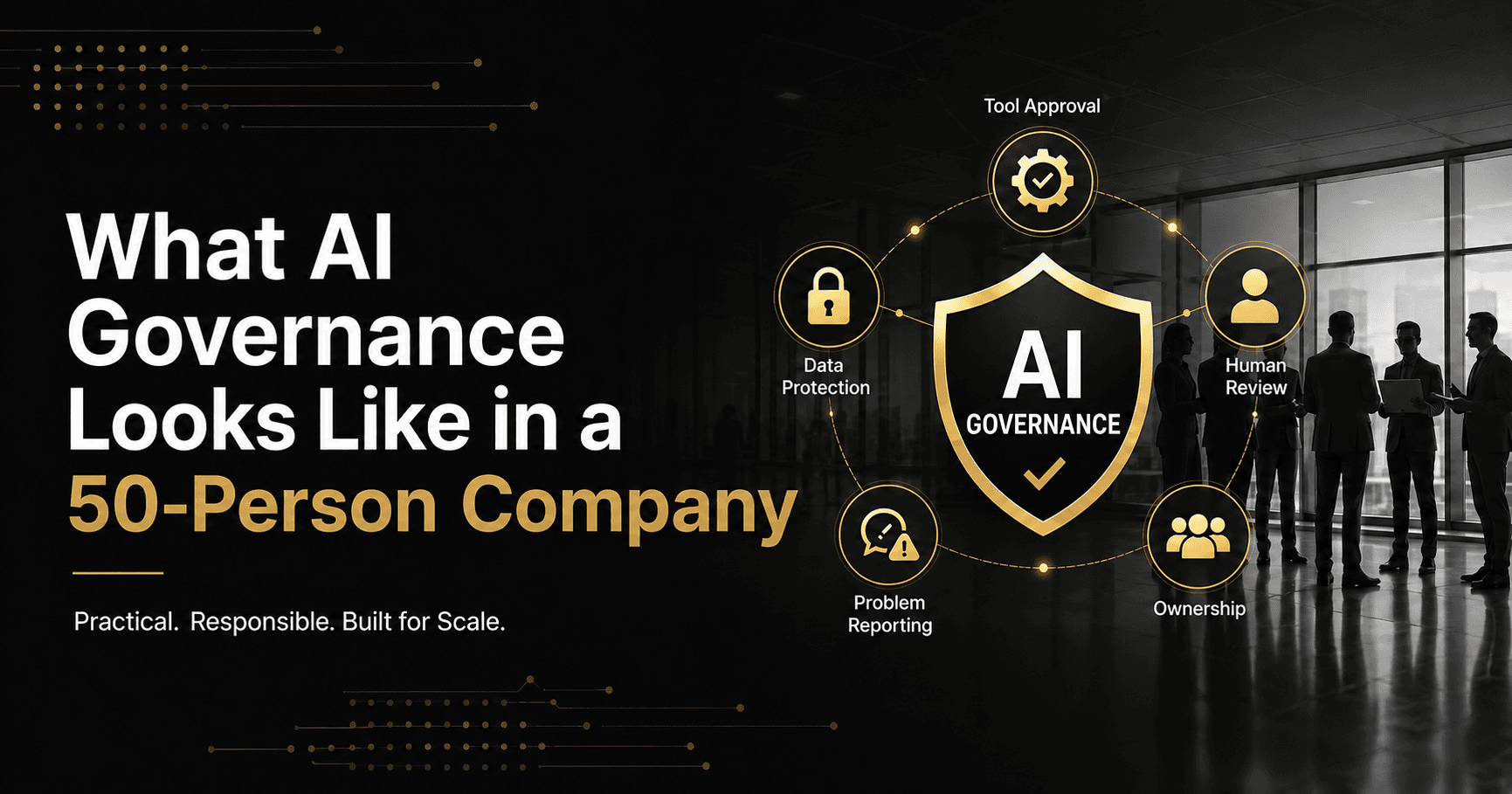
1. Tool Approval
Decide who can approve new AI tools and subscriptions.
This helps prevent duplicate purchases, unmanaged accounts, and tools being adopted without considering security or business value.
2. Data Protection
Define what information employees may not enter into public or unapproved AI systems.
That may include:
- Customer personal information
- Financial information
- Employee records
- Passwords or login credentials
- Confidential contracts
- Proprietary business information
- Protected health information
- Data restricted by customer or vendor agreements
The exact rules should reflect your industry, legal obligations, and client commitments.
3. Human Review
Specify which AI-generated work must be reviewed before it is used. Human review may be especially important for:
- Customer communications
- Public marketing content
- Financial analysis
- Legal or compliance-related material
- Hiring or employee decisions
- Recommendations that could significantly affect a customer
AI can support the work, but responsibility should remain clear. Our full guide on where human review actually belongs walks through how to match the level of oversight to the level of risk for each workflow.
4. Ownership
Assign one person to coordinate AI use across the company. That person does not need to make every decision. They should know:
- Which tools are being used
- Which projects are active
- Who owns each workflow
- What risks have been identified
- When policies need to be reviewed
When everyone owns AI, no one really does.
5. Problem Reporting
Employees should know what to do when an AI tool produces incorrect, inappropriate, biased, or unexpected results.
A simple reporting process can help the company identify recurring issues before they become larger problems.
6. Regular Review
AI tools and business use cases change quickly. Leadership should periodically review:
- Approved tools
- Active AI projects
- Data-handling practices
- Employee concerns
- Quality issues
- Whether each project is still creating value
For many companies, a quarterly or semiannual review may be enough.
Match Oversight to Risk
The purpose of governance is not to control every AI interaction equally. It is to apply the right amount of oversight based on risk.
For example, a marketing employee using AI to brainstorm headline ideas may not need executive approval. An employee using AI to analyze confidential customer information requires much more scrutiny.
A useful rule is:
> The greater the potential impact of an error, the greater the need for review and oversight.
This keeps governance practical. Low-risk use cases can remain flexible, while higher-risk applications receive more attention.
Keep It Simple at First
A 50-person company does not need to solve every governance question immediately. Begin with a few clear decisions:
- Which tools are approved?
- What information is prohibited?
- Which outputs require human review?
- Who owns AI strategy and oversight?
- How should employees report problems?
- How often will leadership review AI use?
That may be enough to create consistency without slowing the business down. More structure can be added as AI use becomes more complex.
A Practical Next Step
At AI2Grow, our AI governance work is built around exactly this: creating practical guidelines that match a company's size, risks, and actual use of AI.
That may mean a simple set of operating rules, a tool approval process, clearer ownership, or a more structured framework. The goal is not to copy what a Fortune 500 company is doing. It is to create enough structure for your business to use AI responsibly without creating unnecessary bureaucracy.
Not sure where to start? Our free AI Readiness Session is designed to help you identify which AI tools your employees currently use, what information they enter, and where the biggest governance gaps are — before those gaps become real problems.
Ready to implement AI the right way?
Let's have an honest conversation about your business and whether we're the right fit.
Schedule a Strategy Call →