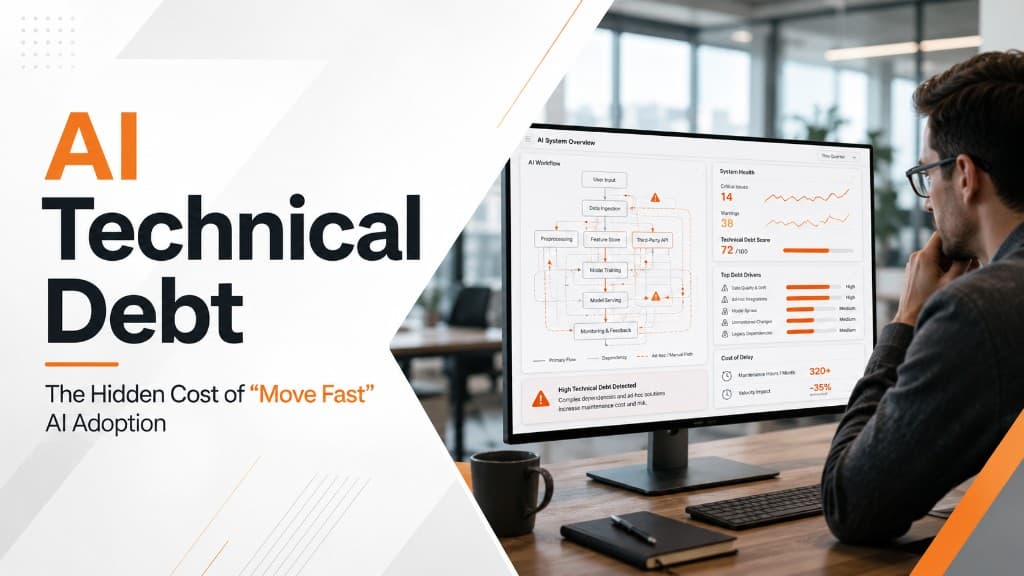
Moving quickly with AI can look like good business judgment.
A team identifies a promising tool, connects it to an existing workflow, and gets something working in weeks instead of months. Employees are excited. Leadership sees early results. The project feels like a win.
But there is an important difference between an AI solution that works today and one the business can maintain, govern, and scale over time.
That gap is where AI technical debt begins.
AI technical debt is the cost and complexity created when an AI system is implemented faster than the business can properly integrate, monitor, secure, maintain, and manage it. Like traditional technical debt in software, shortcuts can create future work. With AI, those shortcuts can also involve data quality, vendor dependence, human review, security, workflows, and accountability.
The problem is not speed itself. The problem is moving quickly without understanding what the business may be committing to later — which is one of the reasons most AI implementations fail.
What Is AI Technical Debt?
Traditional technical debt usually refers to shortcuts in software or infrastructure that make future changes harder or more expensive.
AI technical debt is broader.
It can involve:
- Poor or inconsistent data
- Fragile integrations
- Unclear ownership
- Vendor lock-in
- Weak access controls
- Inadequate testing
- Manual review requirements
- Untracked costs
- Lack of monitoring
- Workflows that depend too heavily on one model or platform
An AI project may look inexpensive when leadership considers only the initial software subscription or implementation cost.
The real cost often appears later.
Employees may spend hours correcting AI-generated work. Data may need to be cleaned before the system can be trusted. Integrations may need to be rebuilt. A vendor may increase pricing. A workflow may stop working after a model or application changes.
That is why businesses should evaluate AI based on total cost of ownership, not just the cost of getting started. Measuring AI ROI starts with that same idea: the business case has to include what it costs to keep the system running, not only what it costs to turn it on.
Where "Move Fast" Starts Getting Expensive
Fast implementation can be completely reasonable when the use case is low-risk, contained, and easy to reverse.
Problems usually begin when speed replaces decisions that should have been made before deployment.
Poor data gets pushed downstream.
If customer records are duplicated, incomplete, inconsistent, or spread across several systems, AI does not automatically fix the underlying problem.
It may simply process bad information faster. That is why business process optimization belongs before a rushed rollout — otherwise the tool just accelerates the mess.
Employees can then spend additional time reviewing, correcting, and reconciling results that looked automated on paper.
A convenient vendor becomes a permanent dependency.
The easiest platform to launch today may determine which models, APIs, data formats, integrations, and pricing structures the business depends on tomorrow.
That does not mean a business should avoid vendors. It means leadership should understand how difficult it would be to move, replace, or shut down the system later. Those are the same questions worth asking before any AI vendor demo.
A prototype quietly becomes production software.
An employee may connect an AI tool to a workflow as a test. It works well enough, so the team begins relying on it.
Months later, the "experiment" may be touching customer information, influencing decisions, or becoming part of a critical process. That is how many projects end up in the pilot project graveyard: something that worked as a demo, but was never designed to operate as a business system.
At that point, the business needs more than a clever prompt.
It needs testing, access controls, monitoring, fallback procedures, documentation, ownership, and a plan for what happens when the AI produces a poor result — including where human review actually belongs.
The Cost Is Not Just an IT Expense
AI technical debt becomes a business problem because much of the cost is hidden inside employee time and operational complexity.
Imagine an AI-assisted workflow that appears to save ten hours per week.
If employees spend four of those hours reviewing, correcting, troubleshooting, and re-running the output, the actual improvement is six hours, not ten.
That does not mean the project failed.
It means the business needs to measure the net result rather than the theoretical automation.
The same principle applies to software costs.
An AI solution may require ongoing expenses for:
- Usage fees
- Integrations
- Data preparation
- Employee training
- Human review
- Security controls
- Monitoring
- Support
- Maintenance
- Future rework
Those costs should be part of the original business case, not discovered after the workflow becomes embedded in daily operations.
When Does Moving Fast Make Sense?
Moving quickly can be a smart strategy when the consequences of failure are limited.
A fast pilot may make sense when:
- The use case is low-risk
- The workflow is easy to reverse
- AI output is reviewed before it affects customers or decisions
- The required data is reasonably clean
- The tool does not need deep integration into critical systems
- Success can be measured within a short period
- The business can stop the experiment without disrupting operations
This is where AI can be useful: a company can test a repetitive process without turning the experiment into permanent infrastructure.
When Should a Business Slow Down?
More planning is appropriate when the consequences of getting the decision wrong become significant.
Leadership should slow down when:
- AI will take actions without human review
- Sensitive or confidential information is involved
- The process affects customers directly
- Several systems need to be integrated
- The workflow is business-critical
- The project creates heavy dependence on one vendor
- Errors could create financial, legal, security, or reputational consequences
- Nobody can clearly explain how performance will be monitored
- The business cannot estimate ongoing operating costs
Slowing down does not mean spending a year planning.
It means matching the amount of diligence to the amount of risk. For growing companies, that is also what practical AI governance is for: enough structure to keep a useful tool from becoming an unowned liability.
A Better Question Before Scaling
Many AI conversations start with:
"Can AI do this?"
That is useful during experimentation.
Before scaling, the better question is:
"Does AI do this well enough to justify the cost, complexity, and risk?"
Leadership should be able to answer:
- What measurable business outcome improved?
- How much employee time is actually saved after review and correction?
- What does the system cost at current usage?
- What happens to cost if usage grows significantly?
- What data does the system rely on?
- Who owns and maintains that data?
- Who is responsible for the AI-enabled process?
- How are poor results identified?
- What happens if the vendor, model, or pricing changes?
- Could the business shut the system down without disrupting operations?
Avoiding Technical Debt Does Not Mean "Go Slow"
Businesses do not have to choose between rushing into AI and spending months analyzing every possibility.
A better approach is controlled experimentation.
Start with a clearly defined problem.
Establish what success looks like before implementation.
Use a narrow pilot.
Measure the result.
Identify the human review required.
Understand the data and security implications.
Then expand only when the workflow demonstrates real value. That is the same sequence a strong first week of AI discovery is designed to produce: clarity before commitment.
A low-risk internal use case may need relatively light governance. An AI system embedded in financial, customer, or core business workflows deserves much more scrutiny. The goal is to keep a temporary shortcut from quietly becoming a permanent dependency.
Useful AI Adoption, Not Maximum AI Adoption
AI2Grow approaches AI adoption from the business problem first.
The question is not:
"How much AI can we add?"
It is:
"Where can AI create measurable value without introducing unnecessary complexity?"
For businesses already experimenting with AI, that can mean reviewing current tools for cost, performance, data readiness, integration complexity, security, and long-term sustainability.
For businesses still evaluating opportunities, it means identifying use cases where the expected value is large enough to justify the technology and the operational changes required.
The goal is not maximum AI adoption.
It is useful AI adoption.
Moving quickly can be an advantage. But the best AI strategy is not the one that launches the most tools in the shortest amount of time.
It is the one that creates measurable business value today without quietly creating a much larger problem for tomorrow.
If you want help reviewing whether a current AI workflow is creating value — or quietly creating debt — our free AI Readiness Session starts with the business problem, not the tool count.
Ready to implement AI the right way?
Let's have an honest conversation about your business and whether we're the right fit.
Schedule a Strategy Call →