Agentic AI is having a moment.
Vendors are talking about agents that can plan, make decisions, use business software, complete tasks, and continue working without someone prompting them at every step.
That sounds powerful.
And in the right situation, it can be.
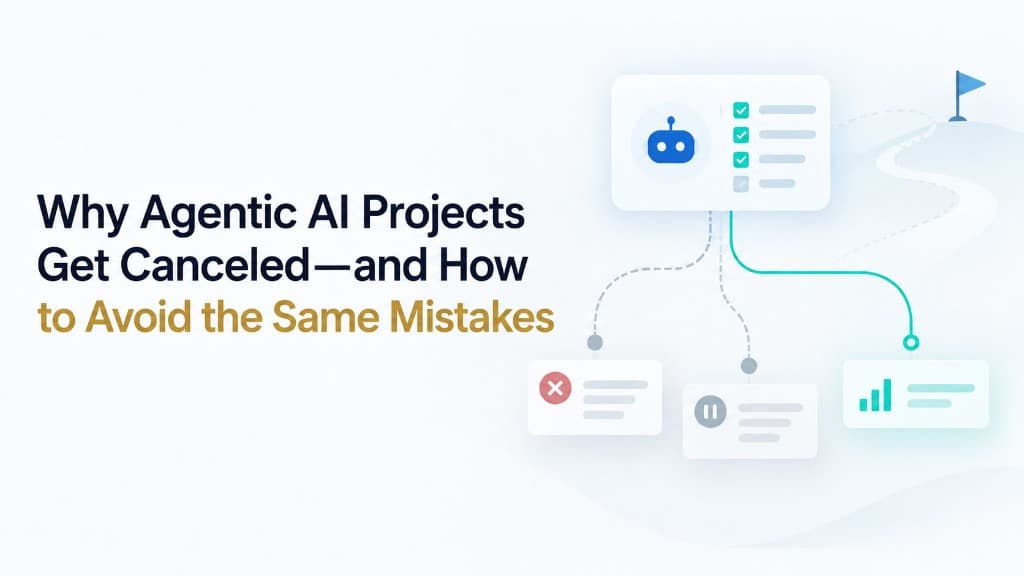
But Gartner predicts that more than 40% of agentic AI projects will be canceled by the end of 2027, citing escalating costs, unclear business value, and inadequate risk controls among the reasons. That does not mean AI agents are doomed to fail. It means many organizations are adopting them before they have answered the most important business questions.
The lesson is not:
"Do not use AI agents."
The better lesson is:
Do not build an AI agent just because agentic AI is the newest thing.
A project should begin with a business problem, a measurable outcome, and a clear reason why an agent is actually the right tool for the job.
What Is Agentic AI?
An AI agent is different from a typical chatbot.
A chatbot generally responds to an individual request.
You ask it to draft an email, summarize a document, brainstorm ideas, or answer a question.
An AI agent can go further.
Depending on the system and the permissions it has been given, an agent may be able to:
- Retrieve information from multiple systems
- Decide what action should happen next
- Use business applications
- Send messages
- Update records
- Trigger workflows
- Check the result of its actions
- Continue working toward an assigned objective
That additional autonomy is what makes agentic AI so interesting.
It is also what makes implementation more complicated.
Once an AI system can act instead of simply recommend, the quality of your business process, data, permissions, integrations, rules, and human oversight becomes much more important. The same distinction appears in how to tell a real AI agent from a repackaged chatbot: the label is less important than what the system can actually do.
Why Are So Many Agentic AI Projects Being Abandoned?
The problem often starts before the technology is ever deployed.
Someone decides:
"We need an AI agent."
Then the company begins searching for something the agent can do.
That is backwards.
A successful implementation should start with the problem, not the technology.
Several common mistakes can make an agentic AI project difficult to justify.
Starting With the Technology Instead of the Business Problem
If the reason for the project is simply "we want to use agents," it is going to be difficult to prove value.
The business should first identify a costly, slow, repetitive, or difficult workflow.
Then determine which technology—if any—is best suited to improve it.
Using an Agent Where Simpler Automation Would Work
Not every workflow needs autonomy.
If a process follows predictable rules and the same steps every time, a conventional automation may be cheaper, easier to maintain, and more reliable.
Using the most sophisticated technology available does not automatically create the best solution.
Giving Immature Technology a Messy Process
Real business processes are rarely as clean as demonstrations.
Information may be missing.
Customers may make unusual requests.
Employees may use inconsistent terminology.
Data may be stored in several different places.
Approvals may depend on judgment rather than fixed rules.
An agent has to operate in that reality—not in the polished demonstration shown during a sales meeting.
Failing to Define Success
"Make employees more productive" is not a useful project target.
How much time should be saved?
How many transactions should the agent process?
What response time should improve?
What manual work should be reduced?
What error rate is acceptable?
Without a baseline and a measurable outcome, leadership will have a difficult time determining whether the system is actually creating value. That is the same problem behind how to measure AI ROI.
Treating a Pilot as Proof of Production Readiness
A controlled pilot can demonstrate possibility.
It does not automatically prove that a system can operate reliably at scale.
Production introduces more users, more edge cases, more data, more integrations, more risk, and more ongoing cost.
The pilot should answer whether the idea deserves further investment—not whether the project is automatically ready for company-wide deployment. Many AI pilots never make it to scale for exactly this reason.
You Probably Do Not Need an AI Agent If...
Before approving an agentic AI project, ask whether the problem truly requires independent action.
A simpler tool may be a better choice if:
- The process follows the same predictable steps every time
- Decisions can be expressed clearly as rules
- A human already knows exactly what information is required
- The task mainly involves generating or summarizing content
- There is little need for the system to take action on its own
- The process happens too infrequently to justify implementation cost
- The potential financial benefit is difficult to measure
- Nobody owns the outcome
There is nothing wrong with using a less sophisticated solution.
In many situations, that is actually the more disciplined technology decision. Knowing when not to use AI is part of choosing the right tool.
When an AI Agent May Make Sense
Agentic AI becomes more interesting when the workflow is both repetitive and complex.
Consider a process where an employee repeatedly has to:
- Receive a request
- Gather information from several systems
- Interpret what the request means
- Determine which workflow applies
- Perform several routine actions
- Check whether those actions were successful
- Escalate unusual cases
That is much closer to the kind of workflow where an agent may create value.
For example, an agent could potentially receive an incoming request, collect relevant information, classify the request, initiate routine actions, update internal systems, and escalate exceptions to a person.
The key point is that the value comes from improving the workflow outcome.
The agent itself is not the value.
Six Questions to Ask Before Building an AI Agent
Before moving from an impressive demo to implementation, put the project through a basic business test.
1. What is the baseline?
How does the process work today?
How much employee time does it consume?
How many people are involved?
How often does it happen?
What delays, errors, or costs are associated with it?
You cannot measure improvement if you do not know where you started.
2. What should improve?
Define the desired result.
That might mean:
- Reducing processing time
- Increasing capacity
- Improving customer response times
- Reducing manual data entry
- Lowering error rates
- Eliminating repetitive steps
- Freeing employees for higher-value work
The target should be specific enough that leadership can evaluate it later.
3. What happens when the process does not go as planned?
This may be the most important implementation question.
What happens when:
- Information is missing?
- Two systems disagree?
- A request falls outside normal rules?
- The agent does not understand the task?
- The system it depends on is unavailable?
Exceptions are often where a polished demo meets operational reality. That is also why the questions worth asking before any AI vendor demo matter more than the happy-path walkthrough.
4. Where should humans remain involved?
Maximum autonomy should not automatically be the goal.
Ask which actions are safe for the agent to perform independently and which should require human review.
An agent may be able to draft a customer response without approval.
Sending it may require approval.
It may be able to recommend a financial action.
Executing that action may need human authorization.
Useful autonomy with appropriate control is usually more valuable than autonomy for its own sake.
5. Do the economics work?
Include more than the software subscription.
Consider:
- Implementation
- Integration
- AI usage costs
- Human oversight
- Maintenance
- Testing
- Monitoring
- Security
- Ongoing changes to workflows and systems
Then compare that cost with the business benefit. SMB AI agent ROI is easy to overstate if you only count the software fee.
A technically successful project can still be a poor business investment.
6. What would cause us to stop?
A responsible pilot should have criteria for:
- Expanding the project
- Modifying it
- Pausing it
- Ending it
One of the most expensive technology mistakes is continuing to fund something simply because the organization has already invested money in it.
The Most Important Question: Why Does This Need an Agent?
This is the question every vendor, internal team, or consultant should be able to answer.
Not:
"What can the agent do?"
Not:
"How advanced is the model?"
But:
"Why does this particular business problem require an agent?"
That one question forces the conversation back to workflow, economics, risk, and measurable value.
And sometimes the correct answer will be:
It does not.
That is not a failure.
It is a good technology decision.
AI Should Solve a Business Problem
Agentic AI has real potential.
But potential is not the same as value.
The companies most likely to benefit will not necessarily be the ones deploying the largest number of agents.
They will be the ones that are disciplined enough to:
- Choose appropriate use cases
- Define measurable outcomes
- Understand costs
- Control permissions
- Keep humans involved where necessary
- Test real-world exceptions
- Stop projects that do not justify continued investment
That is how AI2Grow approaches agentic AI.
We start with the business problem and the existing workflow. Then we determine whether an AI agent, a simpler AI application, traditional automation, existing software, or no new technology at all makes the most sense.
Because the goal is not to say your company has AI agents.
The goal is to build something that creates measurable business value.
If you want help evaluating whether an AI agent is the right tool, our free AI Readiness Session starts with the business problem — not the newest technology.
Ready to implement AI the right way?
Let's have an honest conversation about your business and whether we're the right fit.
Schedule a Strategy Call →