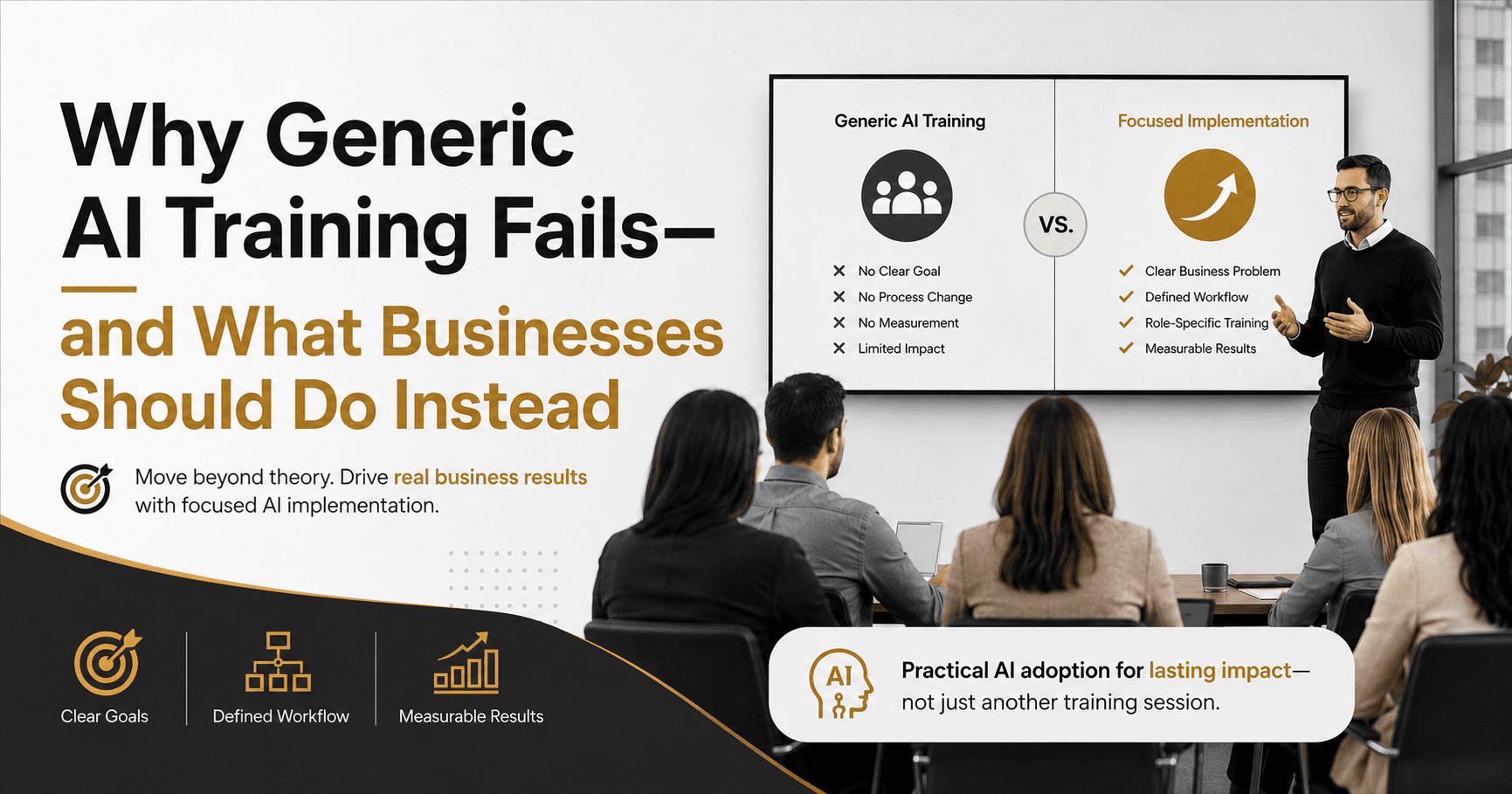
If you are a CEO or business owner trying to figure out how AI fits into your company, you may have been told that the next step is to train everyone on AI.
That sounds reasonable. But for many businesses, it is also backwards.
Before investing in company-wide workshops or encouraging employees to experiment with new tools, ask a more important question:
What business problem are we trying to solve?
If that question does not have a clear answer, broad AI training may create enthusiasm without creating meaningful change. The problem is not training itself. The problem is training without a defined operational goal.
What Does AI Adoption Actually Mean?
AI adoption is not measured by how many employees have access to an AI tool. It is measured by whether AI improves an important business outcome.
That might mean:
- Reducing the time required to prepare reports
- Answering customer questions faster
- Eliminating repetitive administrative work
- Improving accuracy
- Helping employees find information more quickly
- Making a process easier to scale
Successful AI adoption should make a real process faster, more accurate, less expensive, or easier to manage. That is very different from simply teaching employees how to use AI.
Why Generic AI Training Often Disappoints
Many organizations begin with broad AI training because it feels like progress.
Employees attend a workshop, experiment with prompts, and leave excited about what AI might be able to do. Then they return to work. A few weeks later, very little has changed.
Why? Because knowledge without context rarely changes a business process.
Employees may know where work feels slow or frustrating, but they often still do not know:
- Which AI tools are approved
- What information can safely be used
- How the workflow should change
- When human review is required
- How success will be measured
- Who owns the process
Without those answers, AI training becomes an educational experience instead of an operational improvement.
Training Is Not the Problem
AI training can be valuable. But it works best when it is connected to a specific role, workflow, and expected outcome.
For example, generic training might teach employees how to summarize a document.
Focused training would show a specific team:
- Which documents can be summarized
- Which approved tool to use
- What information must be protected
- How the summary should be formatted
- Who must review it
- Where it fits into the workflow
The first approach teaches a capability. The second improves a process.
You May Not Be Ready for Company-Wide AI Training If…
A broad training initiative may not be the right first step if:
- You have not identified a specific process to improve
- Departments are experimenting without shared priorities
- You are hoping employees will discover useful applications on their own
- Your workflows are inconsistent or poorly documented
- Employees do not know which tools are approved
- You have not established rules for confidential information
- You do not know how success will be measured
- Nobody is responsible for turning experiments into implementation
In these situations, training can create more activity, more subscriptions, and more isolated experiments without producing measurable results.
Where Should You Start Instead?
Begin with the work, not the technology. Ask: where does our business lose the most time?
Look for processes that:
- Happen frequently
- Follow consistent steps
- Consume meaningful employee time
- Create repeated delays or errors
- Can be measured
- Can be reviewed by a person
- Frustrate the employees doing the work
These conditions are often better indicators of a strong AI opportunity than general enthusiasm about a particular tool.
A Practical AI Adoption Process
A focused approach can follow five steps.
1. Identify the problem
Define one specific operational challenge. Instead of saying, "We want to use more AI," say:
> Our account managers spend six hours each week preparing routine client updates.
That gives the project a clear starting point.
2. Document the current process
Understand how the work is done today. Identify who performs it, which systems are involved, where delays occur, and which steps require human judgment.
AI cannot reliably improve a process that nobody fully understands.
3. Establish a baseline
Measure current performance before changing the workflow. Track hours spent, turnaround time, error rates, cost, or another meaningful business metric. Without a baseline, you cannot tell whether the new process actually worked — which is exactly how you'd measure AI ROI on any real project.
4. Test with a small group
Begin with the employees closest to the process. A focused pilot is easier to monitor, improve, and measure than a company-wide rollout. It also lets the business identify problems before expanding — and helps avoid ending up in the pilot project graveyard where technically successful demos never become real operational tools.
5. Train the people involved
Once the workflow is defined, provide role-specific training. Employees should understand:
- What the tool is being used for
- What it should not be used for
- Which information is allowed
- How to review the output and when human judgment must lead
- What to do when the output is wrong
- How success will be measured
This is where training becomes useful — because it supports a defined process.
A Practical Example
Imagine that a management team spends several hours each week gathering department updates and preparing a leadership report.
A generic AI workshop might teach employees how to summarize text.
A focused implementation would first document:
- Where the updates are stored
- Who prepares the report
- Which information leadership needs
- Which sections require human judgment
- How long the process currently takes
The company could then test an AI-supported workflow that organizes approved information into a consistent first draft.
Success could be measured by:
- Time required to prepare the report
- Number of corrections needed
- Consistency of the final format
- Whether leadership receives it sooner
That is AI adoption. The training supports the implementation rather than replacing it.
Think of AI as Process Improvement
The companies getting the most value from AI are not necessarily the ones providing the most training. They are the ones solving the right problems.
Sometimes that means training a small group responsible for one workflow. Sometimes it means improving the process before introducing AI. Sometimes the best conclusion is that AI is not the right solution.
That is a perfectly acceptable outcome. Choosing not to force AI into a process where it does not create value is better than implementing it simply because the technology is available.
A Practical Next Step
At AI2Grow, we help businesses identify where AI can create measurable operational value before they invest heavily in tools or training. We begin with the business problem, review the existing workflow, and define what success should look like.
Sometimes the right next step is a focused AI implementation. Sometimes it is process improvement. And sometimes the answer is not yet.
Before scheduling company-wide AI training, identify one business process worth improving. Our free AI Readiness Session is designed to help you find that first process — the one where AI can actually move the numbers — before you commit budget or time to broader adoption.
Ready to implement AI the right way?
Let's have an honest conversation about your business and whether we're the right fit.
Schedule a Strategy Call →