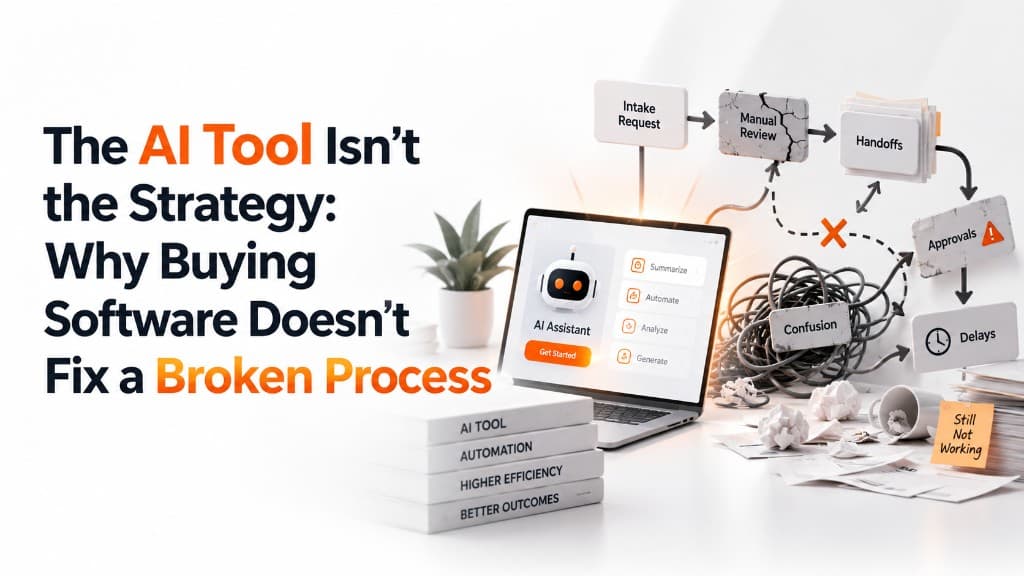
A company buys an AI tool.
The demo looked impressive.
The sales team showed how quickly it could generate content, summarize information, automate follow-ups, analyze documents, and move work from one system to another.
Everyone leaves thinking:
"This is going to save us so much time."
Three months later, the company has another monthly subscription, employees are using the tool inconsistently, and the original process is still frustrating.
What happened?
The AI may not have been the problem.
The process may have been.
This is one of the easiest mistakes businesses can make with artificial intelligence: treating the tool itself as the strategy.
AI can make a well-designed process faster and more efficient.
It can also make a poorly designed process happen faster.
Those are not the same thing.
Start With the Work, Not the Software
When businesses start exploring AI, they often begin by looking at tools.
Which platform should we buy?
Should we use ChatGPT, Copilot, an AI agent, an automation platform, or an industry-specific application?
Those questions matter eventually.
But they come too early.
The better starting point is:
What are we actually trying to improve?
Maybe customer follow-up takes too long.
Maybe employees spend hours every week copying information between systems.
Maybe reports require someone to gather data from six different places.
Maybe the same information is entered three times.
Maybe approvals sit untouched because nobody knows who owns the next step.
Those are business-process problems.
AI may help solve them, but buying software before understanding the workflow often means layering new technology on top of old friction.
Recent McKinsey research makes a similar point. Organizations creating more meaningful value from AI are more likely to redesign workflows and operating models rather than simply add AI tools to existing ways of working.
The technology matters.
But how the work is designed matters just as much.
What Does a Broken Process Look Like?
A broken process does not always look obviously broken.
Sometimes it looks like:
"That's just how we've always done it."
Imagine a company handling new customer inquiries.
The process might be:
- A customer fills out a website form.
- The form sends an email to a shared inbox.
- Someone notices the email.
- That employee manually enters the information into the CRM.
- They send the inquiry to the correct salesperson.
- The salesperson sends an introductory email.
- Someone creates a follow-up task.
- If the prospect does not respond, someone has to remember to follow up again.
There are plenty of places where AI or automation could help.
But before choosing a tool, ask:
- Why does the information need to be re-entered?
- Why does someone manually route the inquiry?
- Who owns the response?
- What happens if nobody sees the email?
- Which steps require judgment?
- Which steps are just moving information?
If you don't answer those questions first, you may build an elaborate AI workflow around steps that should never have existed in the first place.
Automating Waste Doesn't Remove the Waste
Suppose an employee spends ten hours a month producing a report.
The obvious AI question is:
Can AI create the report faster?
Maybe.
But first ask why it takes ten hours.
Perhaps the employee has to:
- Download data from three systems
- Clean up inconsistent names
- Copy numbers into a spreadsheet
- Email another department for missing information
- Reformat everything
- Create charts
- Write a summary
If you ask AI to write the summary, you may save 30 minutes.
Helpful.
But the bigger problem is the time spent gathering, cleaning, and moving information.
The highest-value solution may involve integrating systems, standardizing the data, automatically generating most of the report, and using AI only where it adds value.
That's why the better question is not:
"Where can we insert AI?"
It is:
"What should this process look like if we were designing it today?"
Map the Process Before You Change It
You don't need a six-month consulting engagement to understand a workflow.
Start by writing down what actually happens.
Not what the policy says happens.
Not what management thinks happens.
What employees actually do.
Ask the person performing the work to walk through it step by step.
- Where does the information come from?
- What do you do with it?
- What do you check?
- Who receives it next?
- What happens when something is missing?
- What happens when something unusual occurs?
- Where do you wait?
- Where do you copy and paste?
- Where do mistakes usually happen?
You may discover work nobody realized was happening.
That is often where some of the best AI and automation opportunities appear.
Look for the Friction
Good AI projects usually have a clearly defined source of friction.
That might be:
- Repetitive manual work
- Slow response times
- Duplicate data entry
- Inconsistent output
- Too many handoffs
- Difficult information retrieval
- Large amounts of routine documentation
Once you know where the friction is, you can decide what kind of solution actually fits.
Sometimes AI is appropriate.
Sometimes normal automation is better.
Sometimes the answer is an integration.
Sometimes the process simply needs fewer steps.
Not every business problem needs AI attached to it.
Decide What Humans Still Need to Do
Another mistake is assuming that if AI can perform part of a process, it should perform the entire process.
Different steps carry different levels of risk.
AI might safely:
- Draft a routine follow-up.
- Categorize incoming requests.
- Extract information from documents.
- Summarize notes.
- Prepare a first version of a report.
But you may still want a person to:
- Approve a financial decision.
- Handle an angry customer.
- Confirm a legal or compliance issue.
- Review an unusual exception.
- Authorize a payment.
The goal is not necessarily to remove the human.
The goal is to decide intentionally where human judgment creates value.
Fix the Inputs Before Blaming the AI
Sometimes a new AI tool appears to perform poorly because the business process feeding it is inconsistent.
One employee names files one way.
Another names them differently.
Customer records contain missing fields.
Important instructions live in someone's email.
Policies are outdated.
Nobody agrees on the correct version of a document.
Now AI is being asked to produce a consistent result from inconsistent inputs.
That is not purely an AI problem.
It's an operational problem.
AI often exposes process weaknesses that were already there.
That can actually be useful—if the business is willing to fix them.
Define Success Before Implementation
Before buying an AI tool, decide what improvement you expect.
For example:
- Reduce customer-response time from four hours to 30 minutes.
- Cut weekly reporting work from eight hours to two.
- Reduce duplicate data entry by 80 percent.
- Increase the percentage of leads receiving same-day follow-up.
Those are measurable outcomes.
Compare that with:
"We want to use AI."
One is a business objective.
The other is an activity.
If there is no clear outcome, it becomes difficult to know whether the implementation actually worked.
Redesign the Workflow Instead of Automating Every Step
Go back to the customer-inquiry example.
Instead of automating all eight existing steps, the redesigned process might be:
- Website information goes directly into the CRM.
- Rules or AI classify the inquiry.
- The correct salesperson is assigned automatically.
- AI prepares a personalized first response using approved information.
- The salesperson reviews exceptions.
- Follow-ups are scheduled automatically.
The business didn't simply automate the old workflow.
It redesigned it.
McKinsey's 2026 research found that companies generating stronger AI results are more likely to rethink how work gets done rather than simply deploy tools into existing processes.
The Tool Comes Later
There are hundreds of AI products promising to save time, increase productivity, and automate work.
Some are excellent.
But the best tool used in the wrong process can still produce disappointing results.
At AI2Grow, we believe AI implementation should begin with the business question:
What problem are we actually trying to solve?
Then:
- Understand the process.
- Find the friction.
- Remove unnecessary steps.
- Decide what should be automated.
- Identify where human judgment still matters.
- Define the outcome.
Then choose the technology.
Because AI software can be powerful.
But software by itself is not a strategy.
And if the process underneath it is broken, buying another tool usually won't fix it.
If you want help looking at the process before you choose a tool, our free AI Readiness Session starts with the work — not the software.
Ready to implement AI the right way?
Let's have an honest conversation about your business and whether we're the right fit.
Schedule a Strategy Call →