You ask your new AI system a simple question:
"Which customers haven't heard from us in the last 90 days?"
It gives you an answer immediately.
The problem?
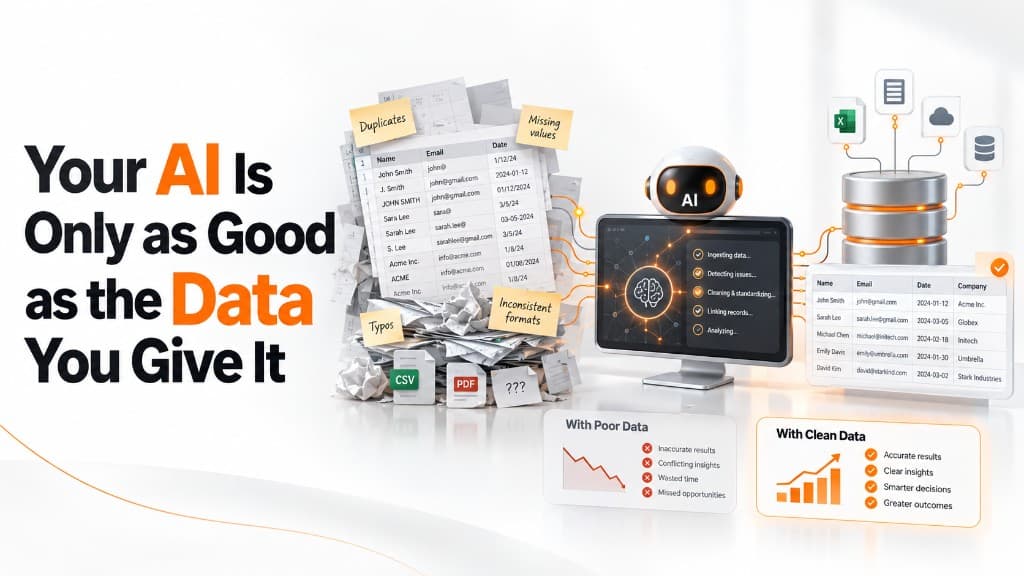
Some customer records use company names.
Others use individual names.
Several customers have duplicate records.
Half the communication history lives in the CRM.
The other half is buried in email.
One department hasn't updated its records in six months.
The AI didn't necessarily fail because it wasn't intelligent enough.
It failed because the information underneath it was unreliable.
This is one of the least glamorous parts of AI implementation—and one of the most important.
AI depends on data.
If that data is incomplete, inconsistent, outdated, poorly structured, or disconnected, AI can produce polished answers that are still wrong.
AI Doesn't Automatically Fix Bad Information
Businesses sometimes imagine AI as a layer of intelligence that can be placed over everything the company knows.
Connect AI to your CRM, accounting system, files, emails, documentation, and internal knowledge base.
Then ask questions.
But there is an assumption buried inside that vision:
The information inside those systems is accurate.
Often, it isn't.
PwC's 2026 Digital Trends in Operations survey of 767 U.S. operations and supply-chain leaders found that 87% said poor data quality had affected their organization's ability to achieve value from digital initiatives. Only about half said their organizations establish a clean, structured data foundation before scaling those initiatives.
That doesn't mean your data must be perfect before you use AI.
It does mean you need to understand what your AI is being asked to trust.
What Does "Bad Data" Actually Mean?
Bad data doesn't always mean incorrect numbers.
It can take many forms.
Duplicate information
You may have:
- ABC Company
- ABC Co.
- ABC LLC
- ABC Company – St. George
All referring to the same customer.
A person may recognize that immediately.
A system may treat them as four different records.
Missing information
One salesperson fills in every CRM field.
Another enters only the customer name and phone number.
Now the business asks AI to analyze customer industries, deal stages, or follow-up history.
The answer will be incomplete because the underlying data is incomplete.
Outdated information
An old policy says employees should follow one process.
The new policy says something different.
Both documents are still stored in the knowledge base.
Which one should AI use?
Inconsistent terminology
One department calls something a "lead."
Another calls it a "prospect."
A third system calls it an "opportunity."
Those differences may seem small to humans.
They can create confusion when systems are connected.
Disconnected information
Your CRM has one piece of the story.
Your accounting platform has another.
Customer-service notes are somewhere else.
Operational information sits in spreadsheets.
Now AI is expected to understand the customer relationship without seeing the complete picture.
AI Can Sound Confident and Still Be Wrong
One reason data quality matters is that AI output often sounds convincing.
NIST uses the term confabulation—commonly called hallucination—for situations where generative AI produces false or erroneous content and presents it confidently. NIST warns that people may act on incorrect output precisely because it appears authoritative.
Poor source data creates another version of the same problem.
The AI may correctly analyze the information it was given.
The information itself may be wrong.
Imagine asking:
"Which customers are overdue for follow-up?"
If your CRM hasn't been updated, the answer may be correct according to the database and completely wrong in reality.
The employee may have spoken with the customer yesterday.
They simply didn't record it.
AI cannot reliably reason from information your business never captured.
Before Connecting AI, Ask Where the Truth Lives
One of the most useful questions in AI discovery is:
"What is the source of truth for this information?"
If you're asking AI about customers, is the CRM authoritative?
If you're asking about pricing, is it the accounting platform?
If you're asking about company procedures, is there one approved policy library?
If you're asking about inventory, which system should AI trust?
Sometimes the answer is:
"It depends."
That's a warning sign.
Before giving AI broad access to information, businesses should know which systems contain authoritative data and how conflicts will be handled.
More Data Isn't Always Better
There is a tendency to assume that the best AI system is the one connected to everything.
Not necessarily.
Imagine asking AI to answer HR questions and giving it access to:
- Current policies.
- Old policies.
- Draft policies.
- Manager notes.
- Archived emails.
- Training documents from five years ago.
Technically, the system has more context.
Practically, it may now have multiple conflicting answers.
The goal is not to give AI all of your information.
The goal is to give it the right information.
PwC's 2026 research found that 89% of respondents agreed actionable data was more important than comprehensive data.
That's an important distinction.
Clean Data Doesn't Mean Perfect Data
This is where businesses sometimes get overwhelmed.
They hear "data readiness" and imagine spending a year cleaning every record they have before beginning an AI project.
That usually isn't necessary.
Instead, clean the data that matters for the specific use case.
If you're automating customer follow-up, focus on:
- Customer records.
- Contact information.
- Last interaction dates.
- Lead stages.
- Ownership.
- Follow-up history.
You probably don't need to clean every accounting record from 2014.
Start with the information required to make the workflow reliable.
Simple Standards Create Better Results
Standardization sounds boring.
It is also valuable.
- How should company names be entered?
- Which CRM fields are required?
- Where should meeting notes be saved?
- What counts as a closed lead?
- How do employees record customer interactions?
- Where does the current version of a policy live?
These are part of AI readiness.
When employees follow consistent processes, AI has more reliable information to work with.
Documentation Is Data Too
Businesses often think of data as numbers in databases.
For generative AI, documents are data too.
- Policies.
- SOPs.
- Sales scripts.
- Service documentation.
- Contracts.
- Training materials.
- Product descriptions.
- Frequently asked questions.
If those documents are inaccurate, conflicting, or outdated, an AI assistant grounded on them can repeat those same problems at scale.
Before building an internal AI knowledge tool, ask:
- Are these documents current?
- Is there one approved version?
- Who owns updates?
- Can employees distinguish drafts from final documents?
- Are old versions archived?
This isn't exciting work.
It is extremely useful work.
Better Data Improves More Than AI
There is another benefit to fixing data quality:
Your business usually gets better even before AI is introduced.
- Cleaner customer records improve sales follow-up.
- Better documentation improves employee onboarding.
- Consistent naming improves reporting.
- Clear ownership improves accountability.
- Integrated systems reduce duplicate work.
AI often gives businesses a reason to finally address information problems they have tolerated for years.
That may be one of the most valuable parts of the project.
Build Feedback Into the System
Even after an AI workflow goes live, data quality needs attention.
Employees should have a simple way to flag:
- Incorrect answers.
- Missing information.
- Outdated documents.
- Duplicate records.
- Unexpected results.
That feedback helps determine whether the problem came from:
- The AI model.
- The prompt.
- The workflow.
- The integration.
- Or the underlying data.
Without that feedback loop, businesses may blame "the AI" for problems that actually originated somewhere else.
Don't Ask AI to Know What Your Business Doesn't Know
Artificial intelligence can summarize large amounts of information.
It can identify patterns.
It can help employees find answers faster.
It can automate parts of workflows.
But it doesn't remove the need for businesses to understand their own information.
At AI2Grow, one of the things we look at before building an AI workflow is whether the data required for the process actually exists, where it lives, and whether it can be trusted.
Because the question isn't simply:
"Can AI do this?"
It is also:
"Do we have the information AI would need to do it correctly?"
Your AI doesn't need perfect data.
But it does need data that is reliable enough for the job you're asking it to do.
And figuring out what "reliable enough" means should happen before AI starts making decisions with it.
If you want help deciding whether the information behind a workflow is reliable enough to use, our free AI Readiness Session starts with the data the process actually depends on.
Ready to implement AI the right way?
Let's have an honest conversation about your business and whether we're the right fit.
Schedule a Strategy Call →