An AI pilot can be surprisingly inexpensive. A small team signs up for a tool, someone spends a few hours configuring it, and employees test it on a limited process. If the early results look promising, the business may decide to expand it.
That is usually when the cost begins to look different.
More employees need accounts, the AI needs to connect to other systems, usage increases, someone has to monitor the workflow, and employees need training. Security, permissions, maintenance, and ongoing support also begin to matter more once the tool becomes part of normal operations.
That does not mean the AI project was a bad investment. It simply means the pilot answered one question: Can this work? Moving from a pilot to everyday business use raises another: What will it cost to operate well?
So What Should You Actually Budget For?
There is no universal dollar amount for AI because every workflow is different. A simple internal writing assistant may be inexpensive to operate, while an AI workflow connected to multiple systems, customer data, and business-critical processes may require much more ongoing support.
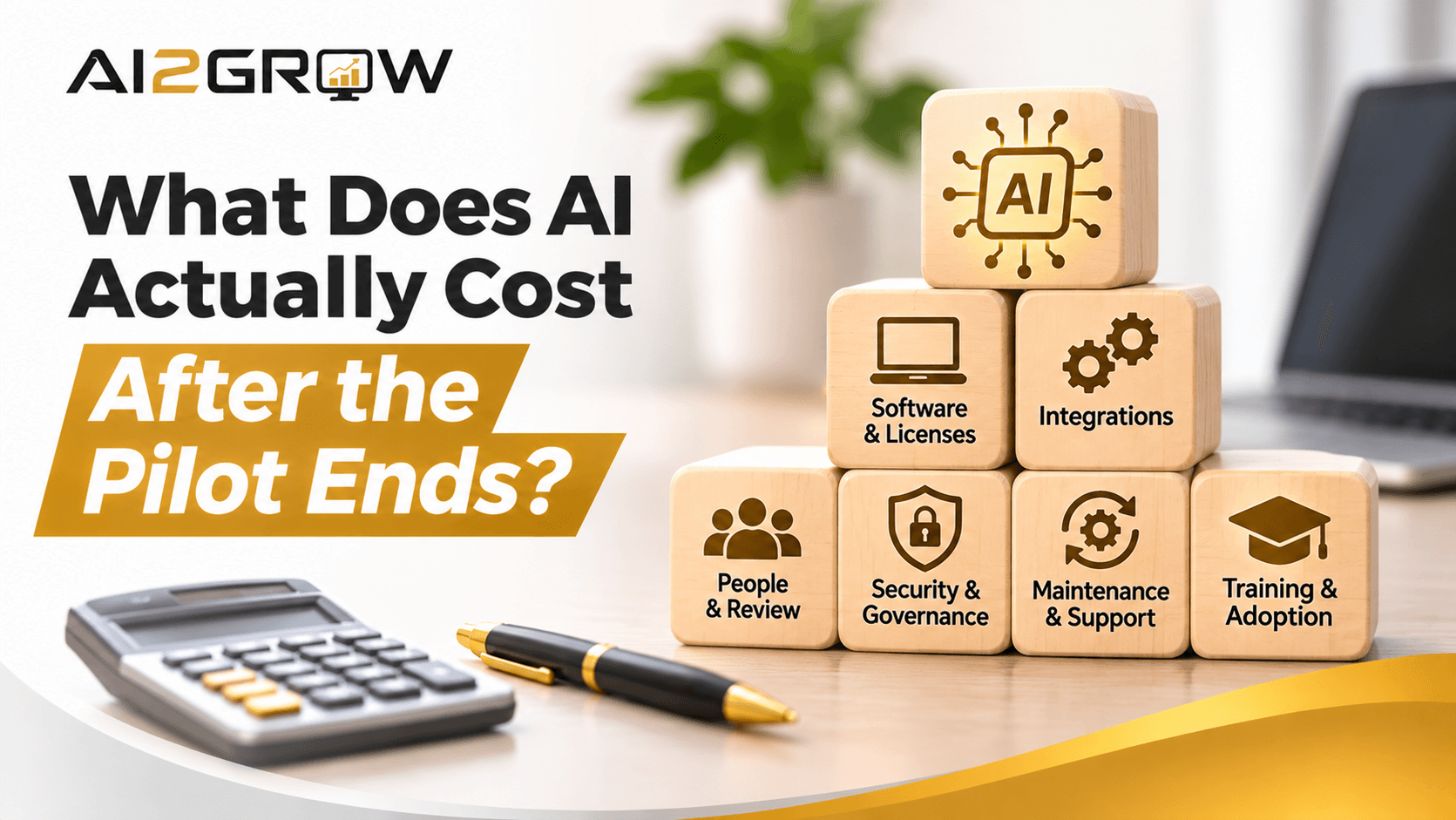
The better way to think about cost is to break it into five buckets:
Technology costs — subscriptions, user licenses, API usage, integration tools, and any other software required to keep the workflow running.
People costs — employee time spent reviewing outputs, handling exceptions, supporting the workflow, and helping others use it correctly.
Maintenance costs — prompt updates, workflow changes, testing, troubleshooting, and adjustments as the business changes.
Security and governance costs — permissions, account management, cybersecurity controls, policy, monitoring, and oversight.
Change costs — documentation, process redesign, training, adoption, and management time.
A simple way to think about it is:
True ongoing AI cost = software + usage + integration + human review + maintenance + training + security/governance
That is the number businesses should compare with the value the AI is creating.
The Subscription Is Only One Part of the Cost
When businesses budget for AI, software pricing is usually the easiest number to see. The platform may charge per user, by monthly subscription, or based on how much the system processes.
That cost matters, but it may be only one piece of the total investment.
An AI workflow can also require implementation, integrations, employee training, maintenance, human review, cybersecurity controls, and ongoing support. A tool that costs $100 per month is not necessarily a $100-per-month solution.
The more useful question is what it costs to keep the entire workflow functioning well.
Usage Can Grow Faster Than Expected
During a pilot, usage is usually limited. A few employees test the system and process a manageable number of requests.
Then the tool works, and more people want access. The company adds new processes, employees begin using the AI more frequently, and the system connects to more information.
If pricing is tied to usage, those costs can grow quickly. That may be perfectly reasonable if the business is receiving more value at the same time, but leadership should understand how the pricing changes as adoption grows.
It is worth knowing whether costs increase with usage, whether there are limits, whether advanced features require a different plan, and whether additional licenses will be needed before rolling the tool out more broadly.
Integrations Can Add Cost
AI becomes much more useful when it connects to the systems where work already happens. That might include a CRM, email platform, file storage, accounting system, project management tool, or internal database.
Those connections may require additional software, API usage, development work, licensing, or technical support. The initial setup is not always the only expense.
Applications change over time. Authentication methods change, fields are renamed, and business processes are redesigned. An integration that works today may need attention six months from now.
Businesses should include that reality in the budget rather than assuming every connection will run forever without maintenance.
Human Review Is Still Part of the Cost
Human review is one of the most overlooked AI expenses.
A workflow might reduce a ten-minute task to two minutes, which sounds like an eight-minute savings. But if an employee then spends four minutes reviewing and correcting the result, the real savings are smaller.
That does not mean the workflow is unsuccessful. Saving four minutes on a task performed hundreds of times can still create meaningful value.
The important thing is to count the review time.
This becomes especially important when AI is involved in customer communications, financial information, sensitive data, or other work where mistakes could have a larger impact. The amount of oversight should match the risk of the task, and whatever human review remains should be treated as part of the operating cost.
Exceptions Have a Cost Too
AI tends to perform best with predictable inputs, but businesses are full of exceptions. A customer request may be unusual, important information might be missing, a document may have an unexpected format, or the AI may not be confident enough to handle the situation.
Someone has to deal with those cases.
During a small pilot, exceptions may be easy to manage. At a larger scale, they can create significant work if they happen frequently.
Businesses should understand how often the workflow requires intervention and how difficult those cases are to resolve. If an employee spends several hours each week cleaning up exceptions, that time belongs in the cost calculation.
Maintenance Is Part of the Budget
AI workflows need care because the business does not stay the same.
Prompts may need updating, company policies can change, products and services evolve, source information gets replaced, and employees may begin using the workflow in new ways. Integrated software changes too.
Someone needs to review those changes and decide whether the AI needs to be adjusted.
The amount of maintenance should match the importance of the workflow. A small internal writing assistant may require almost no formal attention, while an AI system connected to multiple applications and used in a customer-facing process may need regular review.
Maintenance is not a sign that the system failed. It is part of operating the system responsibly.
Security and Governance Have Costs
As AI use grows, businesses also need to think about cybersecurity.
Who has access? What company data can the AI reach? Are employees using approved accounts? Is multi-factor authentication enabled where appropriate? Can access be removed when someone leaves? Are permissions broader than they need to be?
Those controls may require administrative time, security review, stronger account management, or different product plans.
The same applies to governance. Someone may need to establish rules around approved tools, acceptable data use, human review, and what the AI is allowed to do.
These activities are not unnecessary overhead. They are part of operating AI responsibly once it becomes part of the business.
Training Is Not a One-Time Expense
AI tools can appear simple because the interface often is simple. Type something into a box and receive an answer.
Using AI effectively inside a real business process is more complicated.
Employees need to understand what the tool is supposed to do, what it should not do, what information is appropriate to use, how to recognize poor output, and when a person needs to step in.
New employees will need onboarding, and existing employees may need updates as workflows change. Managers also need to understand what has been automated so they can supervise the process effectively.
Training time belongs in the overall investment.
Do Not Forget the Cost of Change
A successful AI implementation often changes the way people work.
Employees may stop creating a report manually and begin reviewing an AI-generated version. A customer request may be routed differently. An approval step may disappear, or managers may begin reviewing only exceptions rather than every transaction.
Those changes can require meetings, documentation, testing, training, and adjustment.
Sometimes the technology is the easy part. Getting people to consistently adopt a new workflow can take more effort than expected.
That work should be included when evaluating the total cost of the project.
Compare Cost With the Right Kind of Value
The answer is not simply to add up every AI-related expense and decide the system is too expensive. Businesses should compare the total cost with the value being created.
That value may include time savings, increased capacity, better consistency, faster customer response, fewer manual errors, better reporting, or the ability to perform work that was not practical before.
Some benefits are easy to calculate. If an AI workflow saves ten hours of manual work each week, the company can estimate the value of that time.
Other benefits are harder to measure. What is the value of responding to customers faster? What is the value of a manager having better information? What is the value of finally documenting a process that previously existed only in one employee's head?
Those benefits still matter, even if they do not fit neatly into a spreadsheet.
A Cheap Tool Can Be an Expensive Workflow
Price should not be confused with cost.
A low-cost AI tool may require employees to manually move information between systems, correct frequent mistakes, or spend hours maintaining it. A more expensive solution may integrate cleanly with existing systems and require much less manual handling.
The cheapest subscription is not always the cheapest business process.
That is why vendor comparisons should look beyond the monthly price and consider what the entire workflow will require to operate well.
Budget for Success, Not Just the Experiment
When planning an AI pilot, businesses should think beyond the first thirty or sixty days.
If the pilot succeeds, how many people will eventually use it? What systems will it connect to? How will usage affect pricing? Who will maintain it? Who will review the output? How much training will be needed? What security controls will be required?
Those questions help turn an experiment into a realistic business case.
So, What Does AI Actually Cost After the Pilot Ends?
Usually, more than the subscription.
But not necessarily more than it is worth.
The real cost is the total investment required to operate the workflow well: software, usage, integrations, human review, maintenance, training, security, and governance.
That number should then be compared with the value the workflow creates.
A successful AI pilot proves that something is possible. A sustainable AI workflow proves that the business can operate it responsibly and receive enough value to justify the ongoing investment.
That is the number that really matters.
Ready to implement AI the right way?
Let's have an honest conversation about your business and whether we're the right fit.
Schedule a Strategy Call →