If a business uses AI to draft customer responses, summarize important information, or automate routine work, the system may eventually become part of daily operations.
But what happens when it stops working—or continues working while producing the wrong answer?
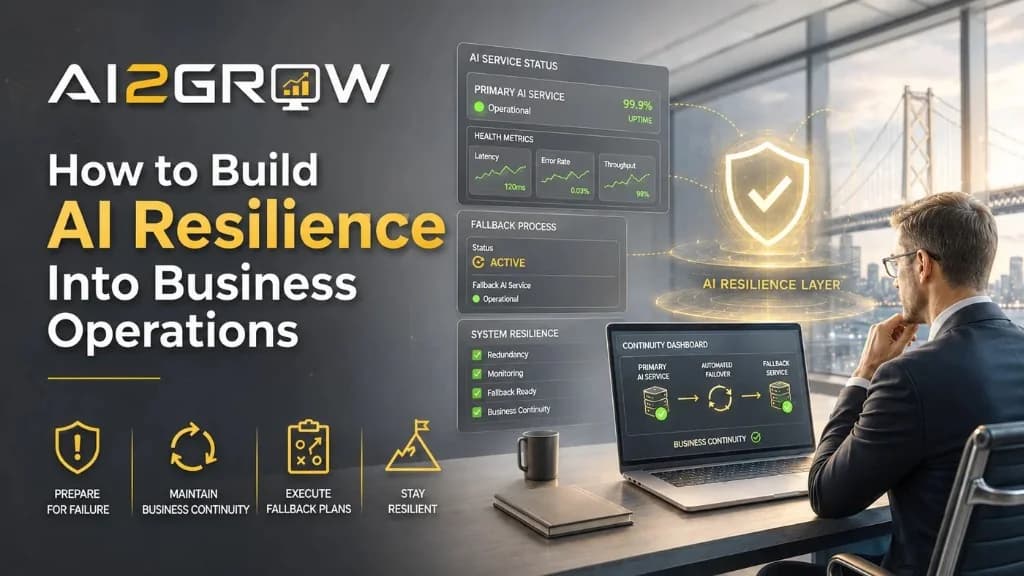
That question is at the heart of AI resilience: a business's ability to continue operating when an AI system becomes unavailable, unreliable, or unsuitable for the situation it encounters.
AI resilience may not receive as much attention as productivity, automation, or new AI capabilities. Yet once a business begins depending on AI, planning for failure becomes just as important as planning for success.
AI failure does not always look like a system outage
One of the biggest misconceptions about AI is that it either works correctly or fails completely.
In reality, AI problems usually fall into three categories.
1. Availability failure
An availability failure occurs when the AI tool cannot be accessed or used.
This might happen because:
- The AI provider experiences an outage.
- An integration stops working.
- Internet service is interrupted.
- An employee loses access to the platform.
- Usage limits or billing issues temporarily disable the service.
This is the most obvious type of failure because the system simply stops responding.
2. Quality failure
A quality failure can be harder to detect because the AI continues producing answers.
Those answers, however, may be:
- Inaccurate
- Incomplete
- Outdated
- Inconsistent
- Based on the wrong information
- Inappropriate for the situation
This type of failure can create more risk than an outage because employees may not immediately realize that something is wrong.
3. Process failure
Sometimes the AI itself works, but the business process surrounding it breaks down.
For example:
- The AI uses outdated company information.
- Employees do not know when human review is required.
- Access permissions allow the wrong people to view sensitive information.
- An automated workflow sends an output to the wrong system.
- No one is responsible for monitoring the process.
In these situations, the technology may be functioning exactly as designed, but the overall business outcome is still unreliable.
A simple example: AI-assisted customer communication
Consider a company that uses AI to draft responses to common customer questions.
At first, the tool saves employees time. Staff members enter the customer's question, receive a suggested response, review it, and send it.
Over time, the company becomes more comfortable with the system. Employees review fewer responses, and the AI becomes part of the normal customer-service process.
Then one of three things happens.
The AI provider experiences an outage, leaving employees without the tool they now rely on.
The AI produces an inaccurate answer based on outdated company information.
Or an automated workflow sends a response before an employee has reviewed it.
None of these situations necessarily creates a major crisis. But without a backup process, employees may not know how to respond, customer communication may slow down, and incorrect information may be shared.
A resilient process would include:
- Approved response templates employees can use manually
- Current company information that is reviewed regularly
- Human approval for sensitive or unusual questions
- A clear procedure for working without the AI tool
- Someone responsible for monitoring response quality
The goal is not to assume the AI will fail constantly. It is to make sure the business does not stop functioning when something goes wrong.
Not every business needs a formal AI resilience strategy
A detailed resilience plan is not necessary for every organization.
A simple backup process may be enough when:
- Employees are only experimenting with public AI tools.
- AI is not involved in customer-facing or essential work.
- The same task can easily be completed manually.
- AI is used occasionally rather than every day.
- The business is still deciding whether AI has a meaningful role.
There is no reason to create a complicated framework for technology that is not yet business-critical.
However, the level of planning should increase as the business becomes more dependent on AI.
When AI resilience becomes more important
A structured backup plan deserves serious consideration when:
- AI supports customer communications or service.
- Automated AI workflows affect daily operations.
- Employees rely on AI to find or summarize important information.
- AI contributes to financial, legal, compliance, or operational decisions.
- An AI outage would significantly interrupt work.
- Multiple systems depend on the same AI provider or integration.
The most important question is not how advanced the AI is.
It is how much the business depends on it.
A simple AI assistant used occasionally may create very little operational risk. A similar tool embedded in quoting, customer service, scheduling, or internal reporting may create much more.
What should an AI backup plan include?
An AI backup plan does not need to be lengthy. It should answer a few practical questions.
How will the work continue?
Employees should know how to complete the process manually or use an alternative system if the AI becomes unavailable.
That may include:
- Manual instructions
- Approved templates
- Alternative software
- Escalation procedures
- Contact information for the technology provider
Where is human review required?
Not every AI output needs the same level of oversight.
Low-risk tasks, such as organizing internal notes, may require minimal review. Customer-facing, financial, legal, or compliance-related outputs may require approval before they are used.
The review process should reflect the potential business impact of an incorrect answer.
Is the information reliable and current?
AI systems are only as useful as the information available to them.
Businesses should identify:
- Which documents or data sources the AI uses
- Who is responsible for updating that information
- How often it is reviewed
- What happens when two sources conflict
An AI system using outdated pricing, policies, or procedures can continue operating while quietly producing poor results.
Who is monitoring the system?
Someone should be responsible for noticing when an AI-supported process changes or becomes unreliable.
Monitoring may include:
- Reviewing a sample of AI outputs
- Tracking employee corrections
- Watching for unusual customer complaints
- Checking whether integrations are working
- Reviewing changes made by the AI provider
Without clear ownership, problems may continue because everyone assumes someone else is watching.
How are access and security managed?
AI tools should follow the same basic security standards as other business systems.
That includes:
- Individual user accounts
- Appropriate access permissions
- Multifactor authentication
- Timely removal of former employees
- Controls around sensitive information
- Review of third-party vendors and integrations
AI should not become an exception to normal security practices simply because the technology is new.
Has the fallback process been tested?
A backup plan is only useful if employees can follow it.
Businesses should occasionally test an AI-supported process without using the AI. This helps confirm that:
- Manual instructions are still accurate
- Employees understand the procedure
- Required information remains accessible
- Work can continue at an acceptable level
The test does not need to be disruptive. Even a brief walkthrough can reveal gaps before a real outage or error occurs.
AI resilience starts with business resilience
Businesses do not necessarily need to invent an entirely new discipline to prepare for AI failures.
Many of the same principles already used in business continuity and disaster recovery can be extended to AI-supported processes:
- Identify critical systems.
- Understand dependencies.
- Assign responsibility.
- Create fallback procedures.
- Test the plan.
- Update it as the business changes.
The difference is that AI failure may be less visible than a power outage or broken server. An AI system can appear to be working while producing unreliable results.
That makes human judgment, process ownership, and regular review especially important.
Where AI2Grow fits
At AI2Grow, resilience is part of the AI planning process from the beginning.
That does not mean every business needs a formal resilience program. It means every meaningful AI implementation should include an honest discussion about what happens when the tool is unavailable, the output is incorrect, or the surrounding process does not work as intended.
Sometimes the answer is a targeted AI implementation with a clear fallback process. Sometimes a business needs stronger data or operational procedures before introducing AI. In other cases, AI may not be the right solution at all.
The goal is not to maximize AI adoption.
It is to help businesses implement technology they can use confidently, support responsibly, and continue operating without when necessary.
AI2Grow offers a complimentary consultation for businesses evaluating where AI may create value, what risks should be addressed, and whether the organization is ready to support the technology over time.
Ready to implement AI the right way?
Let's have an honest conversation about your business and whether we're the right fit.
Schedule a Strategy Call →