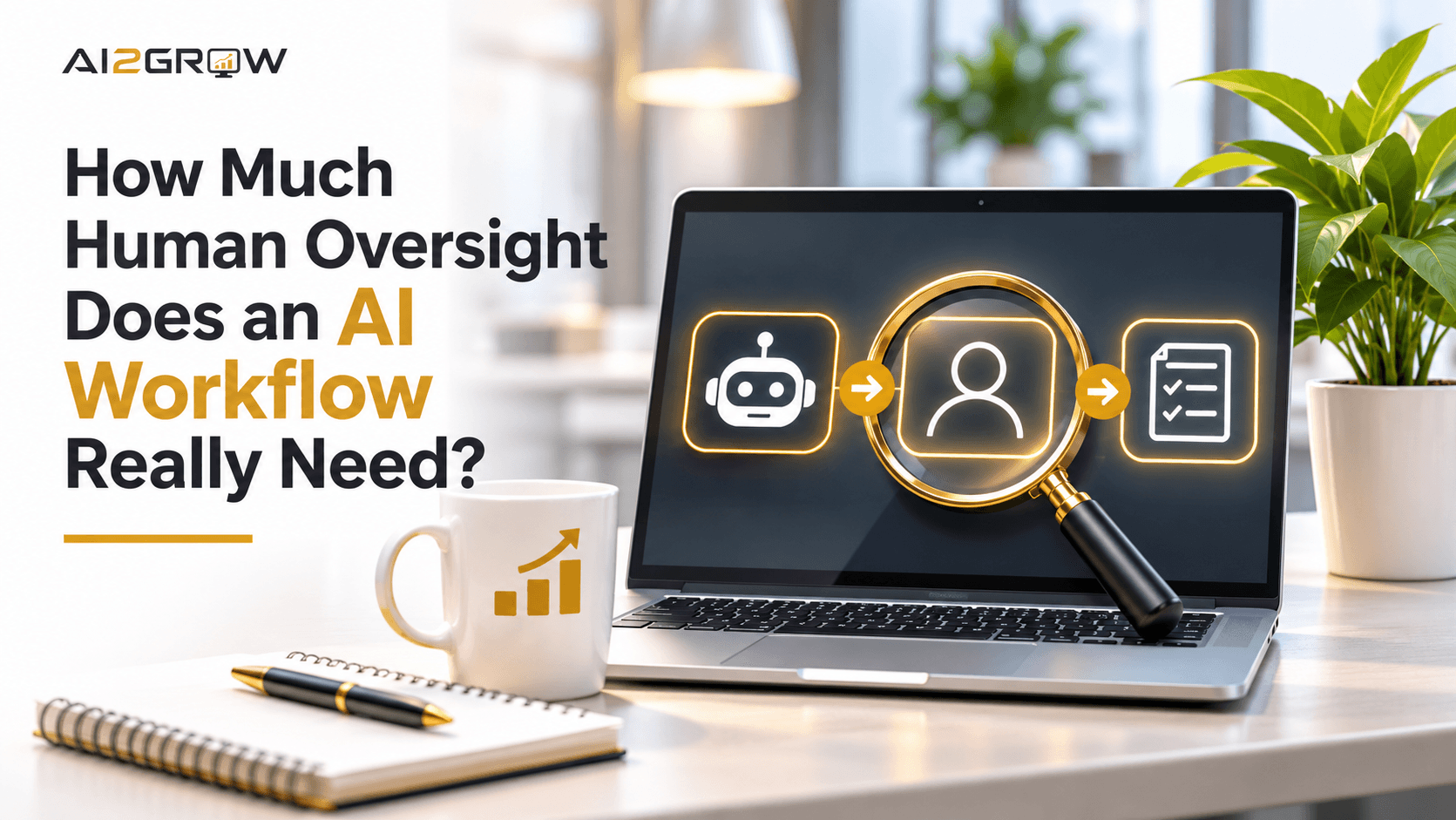
"Keep a human in the loop" has become common advice for businesses using AI. It sounds sensible, but it raises another question: How much human involvement is actually enough?
If a person has to review every AI output in detail, the business may lose much of the efficiency it hoped to gain. On the other hand, removing human review completely can create unnecessary risk.
The right answer usually depends on what the AI is doing, how often it is wrong, and what happens if a mistake reaches the real world. Human oversight should not be treated as a simple yes-or-no decision. It should be designed around the risk of the workflow.
Start With the Consequence of a Mistake
The easiest place to begin is by asking what happens when the AI gets something wrong.
If an AI tool creates a weak internal brainstorming list, the consequence may be very small. Someone reads it, ignores the poor suggestions, and moves on. If AI is drafting a customer communication, the risk is higher because incorrect information could reach someone outside the company.
If the system is making recommendations or taking actions involving money, employment, legal obligations, safety, or other high-impact decisions, the consequences may be greater still.
The higher the potential impact, the stronger the case for human review. This helps businesses avoid treating every AI task as if it carries the same level of risk.
Full Review Makes Sense in Some Situations
Some workflows may need a person to review every output before anything happens.
That can make sense when the AI is new, the process is high risk, or mistakes would be difficult to reverse. For example, a business testing an AI-generated customer response system may initially require employees to review every message before it is sent.
That gives the company time to understand the quality of the output and identify common problems. Full review can also be useful during the early stages of implementation when the team is still learning how the system behaves in real situations.
Once the business understands the workflow better, the oversight model may change.
Sampling Can Work for Stable, Lower-Risk Workflows
Not every AI output needs individual approval forever.
For a stable, lower-risk process, periodic sampling may be enough. The business might review a percentage of outputs each week to make sure the system is still performing as expected.
Sampling can help identify gradual changes in quality without requiring employees to inspect every item. It can also make sense when the workflow handles a large volume of routine tasks where the consequences of an occasional mistake are limited and easy to correct.
The sample still needs to be meaningful. The appropriate amount depends on the volume, risk, history, and consistency of the workflow.
Exception-Based Review Can Save Time
Another option is to have people review only cases that fall outside normal expectations.
The AI may be allowed to handle routine situations while unusual or uncertain cases are sent to a person. For example, an AI system could categorize standard requests automatically but escalate anything it cannot classify reliably.
This can preserve much of the efficiency while keeping humans involved where judgment is more valuable.
Exception-based review works best when the workflow can identify uncertainty or unusual conditions. It should also be paired with periodic quality checks, because AI systems can sometimes produce incorrect answers with high confidence.
Thresholds Can Define When People Step In
Businesses can also create clear thresholds for human involvement.
An AI workflow might be allowed to handle actions below a certain dollar amount but require approval above it. A customer service system might process routine requests automatically while sending refunds, complaints, or unusual situations to a manager.
A reporting workflow may publish standard internal summaries automatically but require review if the numbers change dramatically from the previous period.
Thresholds make human involvement predictable. Employees know when they are expected to step in, while the AI does not have to wait for approval on every low-risk action.
Review Should Focus on the Right Things
Telling employees to "check the AI" is not enough. People need to know what they are checking.
For one workflow, factual accuracy may be the main concern. For another, tone may matter more. In another case, the employee may need to confirm that the AI used the correct customer record or followed the right policy.
The review process should focus on the specific risks of the task.
Otherwise, employees may simply scan the output quickly and approve it without really knowing what they are supposed to catch.
Good human oversight is targeted, not just present.
Too Much Review Can Become Meaningless Review
There is another problem businesses should watch for. If employees are required to review too many AI outputs, they may begin approving them automatically because the AI is usually correct.
At that point, the business technically has a human in the loop, but the oversight may not be very meaningful.
This is one reason adding an approval step does not automatically make a workflow safer. The reviewer needs enough time, context, and responsibility to make a real judgment.
If people are expected to click through hundreds of outputs as quickly as possible, the review process itself may need to be redesigned.
Oversight Should Change as the Workflow Matures
The amount of human review needed on day one may not be the amount needed six months later.
A new workflow often deserves heavier oversight because the business does not yet understand how it behaves in real-world situations. As the system becomes more stable and the team gathers evidence about its performance, review may be reduced.
The opposite can also happen. If errors begin increasing, source information changes, or the AI is used for a broader range of tasks, more review may be needed again.
Human oversight should be adjustable rather than locked into the original design forever.
Monitor the Workflow, Not Just Individual Outputs
Human oversight does not always mean reviewing individual results. Businesses should also monitor the performance of the overall workflow.
Are error rates increasing? Are employees correcting the same issue repeatedly? Are exceptions becoming more common? Are customers reporting new problems? Is the workflow still saving time?
Those patterns may reveal issues that are difficult to see by reviewing one output at a time.
Good oversight looks at both individual cases and the health of the system as a whole.
Keep Humans Where Judgment Matters
AI is especially valuable for repetitive, predictable work. Humans become more important when the situation involves ambiguity, relationships, values, or tradeoffs.
A customer may technically qualify for a standard response, but an employee may know the situation deserves more care. An AI may recommend the option that appears most efficient, while a manager understands that another choice fits the company's long-term strategy better.
These are the situations where human judgment is difficult to replace.
Businesses should identify the points in a workflow where judgment matters most and make sure people remain involved there.
Human Oversight Has a Cost
It is also important to remember that review takes time.
If a business claims an AI workflow saves ten hours but employees spend eight hours reviewing the output, the real savings are much smaller. That may still be worthwhile if quality improves or the work becomes more consistent, but the company should measure the actual result.
Human oversight should be part of the business case from the beginning.
The goal is not to minimize human involvement at all costs. It is to use human attention where it adds the most value.
There Is No Universal Percentage
Businesses sometimes want a simple answer such as "Review 10 percent of AI outputs."
There is no universal number that fits every workflow.
The right amount depends on the consequence of errors, the stability of the system, the quality of the data, the reversibility of the action, and how much judgment the task requires.
High-consequence tasks may require approval every time. Stable routine tasks may need sampling. Unusual cases may be escalated automatically. Different workflows deserve different oversight models.
The Goal Is Meaningful Oversight
Human oversight should not exist simply so the business can say a person was involved. It should have a purpose.
That purpose may be to prevent high-impact mistakes, catch unusual situations, protect customer relationships, validate quality, or provide judgment where AI lacks context.
When businesses understand why a human is involved, it becomes much easier to decide how much oversight is necessary.
AI can remove a great deal of repetitive work. Human judgment should remain where it matters most.
The goal is not to keep people in every step of the process. It is to keep them in the right steps.
Ready to implement AI the right way?
Let's have an honest conversation about your business and whether we're the right fit.
Schedule a Strategy Call →