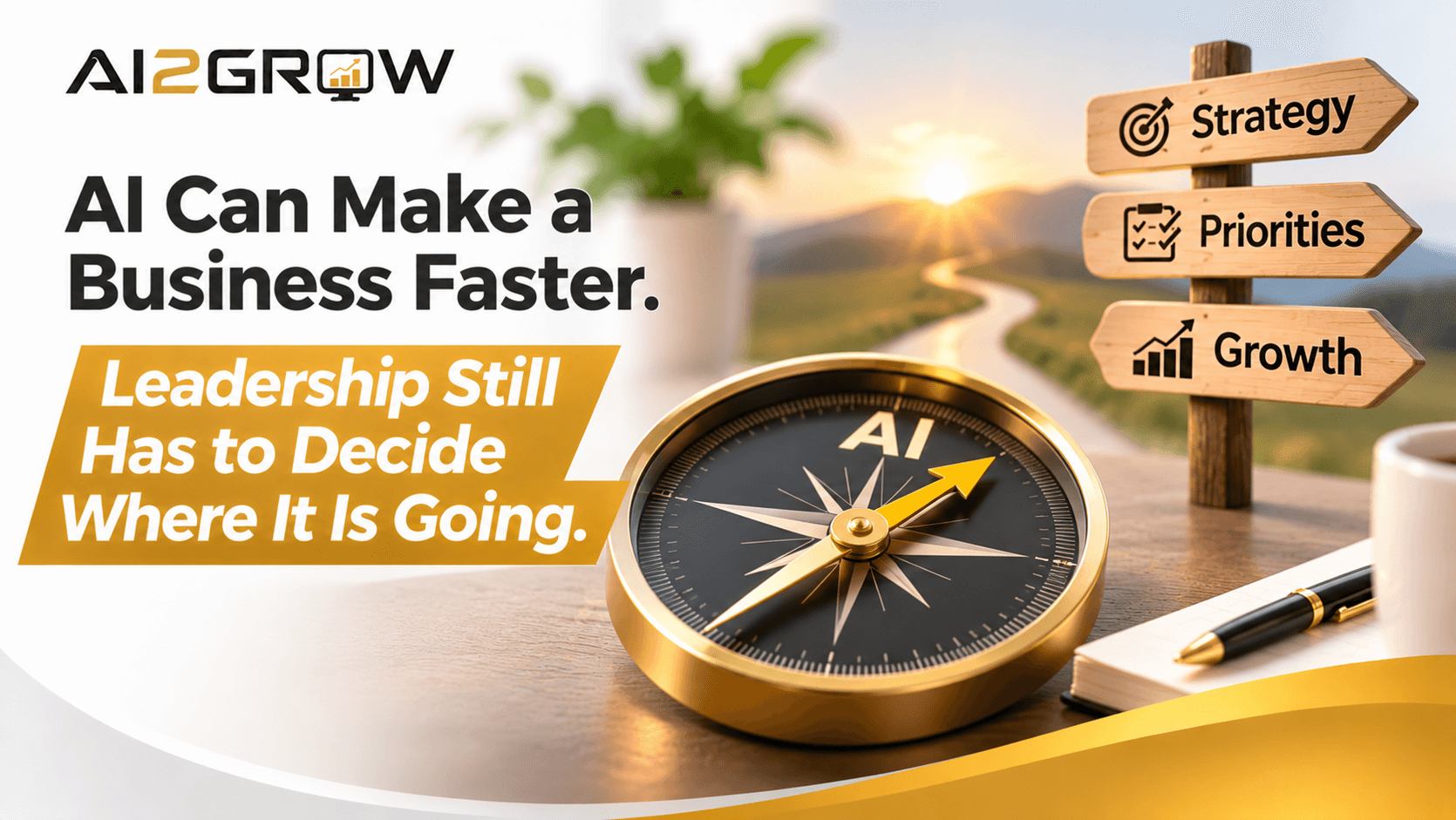
AI can make a business move faster. It can produce drafts in seconds, analyze information quickly, automate repetitive work, summarize large amounts of data, and help employees accomplish tasks that once took hours.
That speed is powerful, but it can also create a problem if the business is not clear about where it is trying to go.
Doing the wrong thing faster is still doing the wrong thing.
That is why AI strategy cannot be separated from business strategy. AI may help a company execute more efficiently, but leadership still has to decide what matters, what should change, and what the organization is trying to accomplish.
Speed Is Not the Same as Direction
Imagine a business that uses AI to produce more marketing content.
The team can now create twice as many articles, emails, and social posts as before. That sounds productive, but what if the company has never decided who it is trying to reach, what makes the business different, or what message it wants customers to remember?
AI may simply help the business create more content that does not accomplish anything.
The same problem can appear in operations, sales, customer service, or reporting.
AI can make an existing process faster, but that does not automatically make the process better.
Leadership still has to define what better means.
Start With the Business Goal
Before asking how AI can help, leaders should know what the company is trying to improve.
Maybe the priority is reducing customer response times. Perhaps the business wants to improve margins, create capacity for growth, reduce errors, improve employee experience, or gain better visibility into operations.
Those are business goals.
Once the goal is clear, AI becomes one possible tool for reaching it.
Without that clarity, businesses often end up chasing capabilities. They see an AI tool that can summarize meetings, so they start summarizing meetings. Another tool creates reports, so they create more reports.
The question should not be, "What can this AI do?"
It should be, "Does this help us accomplish something that matters?"
AI Can Amplify a Good Process—or a Bad One
Automation tends to magnify whatever process already exists.
If the underlying process is clear, consistent, and useful, AI may help it run more efficiently. If the process is confusing, unnecessary, or poorly designed, automation can make the mess happen faster.
Imagine a company where leads are handled inconsistently because nobody has clearly defined who owns different types of opportunities.
Adding AI to automatically route those leads may not solve the real problem. The business still has to decide how leads should be assigned.
The AI can execute that decision once it exists.
It cannot make an unclear business process clear simply because it has been automated.
Leadership Still Has to Make Tradeoffs
AI can provide information and recommendations, but businesses still have limited time, money, and attention.
Leadership has to choose where to invest those resources.
Should the company focus on improving customer service or reducing administrative workload? Should it automate an existing process or redesign it first? Should it invest in a custom workflow or use a simpler tool?
Those decisions involve tradeoffs.
AI can help leaders understand options, analyze information, or model scenarios, but it cannot remove the need to choose.
In fact, as AI creates more possibilities, prioritization may become even more important.
A company may identify twenty things it could automate. Leadership still has to decide which two or three deserve attention first.
More Data Does Not Automatically Create Better Decisions
AI can make it easier to analyze large amounts of information.
That is valuable, but leaders can still become overwhelmed by information.
A business might suddenly have more dashboards, reports, summaries, forecasts, and recommendations than anyone has time to use.
The goal should not be to generate the maximum amount of insight. It should be to identify the information that helps people make better decisions.
Leaders need to decide which questions matter.
What do we need to know before hiring? Which customer trends would cause us to change our service? Which operational metrics tell us whether a process is improving?
AI can help find answers, but leadership still needs to define the questions.
AI Should Support Priorities, Not Create Them
One useful way to evaluate AI opportunities is to compare them with the company's existing priorities.
If reducing customer wait time is a major goal, AI projects that improve response, routing, scheduling, or support may deserve attention.
If employee capacity is the biggest constraint, AI that reduces repetitive administrative work may be more valuable.
If the company is trying to improve profitability, leaders may focus on workflows that reduce waste, improve utilization, or create better visibility into costs.
This does not mean businesses should never experiment outside their current priorities. Experimentation can reveal opportunities leadership did not expect.
But the largest investments should have a clear connection to where the business is trying to go.
Faster Does Not Always Mean Better for Customers
AI can dramatically reduce the time required to respond to customers, but customers do not always value speed above everything else.
Sometimes they need empathy, judgment, context, or someone willing to take ownership of a complicated situation.
A response generated in three seconds is not an improvement if it is impersonal, inaccurate, or fails to solve the actual problem.
Leaders need to decide what customer experience they want to create, and then AI can be used to support that experience.
Maybe it handles routine questions quickly while employees spend more time on complicated cases. Maybe it helps staff find information faster so they can provide better answers.
The goal is not simply faster customer service. It is better customer service, with speed used where it helps.
Creating Capacity Requires a Plan
AI can save employees time, but leadership still needs to decide what happens to that time.
If AI reduces five hours of administrative work each week, where should that capacity go?
Maybe employees should spend more time with customers. Perhaps managers need more time for coaching. Maybe the company has strategic projects that continually get pushed aside.
Without a plan, the saved time may simply disappear into more email, more meetings, or more low-value work.
AI creates the opportunity.
Leadership determines what the opportunity becomes.
AI Cannot Decide What the Company Stands For
There are also decisions AI should not make for leadership.
AI can help analyze customer feedback, but leadership decides which customers the business wants to serve. It can compare pricing options, but leaders decide how the company wants to position itself.
It can even help draft company values, but it cannot determine what leaders are actually willing to uphold when those values become inconvenient.
Direction involves judgment, priorities, culture, risk tolerance, and values.
Those responsibilities remain human.
Ask Better Questions Before Looking for AI
Instead of beginning with, "Where can we use AI?" businesses may get better results by asking:
Where are we trying to grow?
What is slowing us down?
Where are customers experiencing friction?
What work is consuming valuable employee time?
What decisions are difficult because information is hard to access?
What do we want employees to spend more time doing?
Those questions expose the business needs first.
AI can then be evaluated against them.
Use AI to Accelerate a Clear Direction
AI is extremely good at making certain kinds of work faster. That can be a real competitive advantage. But speed has the most value when the business knows what it is accelerating toward.
Leaders still have to choose priorities, define outcomes, make tradeoffs, and decide where human judgment belongs. They also need to be willing to say no to AI projects that are interesting but do not meaningfully support the business.
The goal is not to become the company using the most AI.
It is to become a better company with the help of AI.
AI can provide the speed. Leadership still provides the direction.
Ready to implement AI the right way?
Let's have an honest conversation about your business and whether we're the right fit.
Schedule a Strategy Call →